

-
1 command repetition
English-Russian dictionary on nuclear energy > command repetition
-
2 command\ repetition\ line
строка повторения команды. Строка в маске результата BMML, в которой повторно указывается BMML-команда, к которой относится данная маска.Англо-русский cловарь терминов и сокращений по мобильной радиосвязи стандарта GSM > command\ repetition\ line
-
3 command
functional command — функциональная команда, команда управления
command word — командное слово; команда
-
4 pulse
1) разделитеьный
2) <scient.> импульс
3) толчок
4) пульсировать
5) импульсный
– add pulse
– anticoincidence pulse
– biasing pulse
– bidirectional pulse
– black-out pulse
– blanch pulse
– blanking pulse
– boosting pulse
– break pulse
– carrier-frequency pulse
– carry pulse
– clip a pulse
– clocbe pulse
– clock pulse
– code pulse
– coincidence pulse
– color-identification pulse
– command pulse
– compress a pulse
– conte pulse
– control pulse
– count pulse
– creeping-wave pulse
– delay a pulse
– delay pulse
– dialing pulse
– digit pulse
– dirge pulse
– disabling pulse
– discharge pulse
– disturbing pulse
– drive pulse
– droop of pulse
– echo pulse
– enabling pulse
– equalizing pulse
– equispaced pulse
– erase pulse
– execute pulse
– firing pulse
– flyback pulse
– forerunner pulse
– frame pulse
– full-sized pulse
– gate pulse
– Gaussian pulse
– generate a pulse
– giant pulse
– high-power pulse
– Hilbert pulse
– identification pulse
– incoming pulse
– information pulse
– inhibit pulse
– initiating pulse
– input pulse
– interfering pulse
– interrogation pulse
– ionization pulse
– keying pulse
– light pulse
– main pulse
– make pulse
– marker pulse
– narrow pulse
– narrow-band pulse
– negative pulse
– outgoing pulse
– output pulse
– paired pulse
– parasitic pulse
– partial-read pulse
– peaky pulse
– post-equalizing pulse
– pre-equalizing pulse
– pulse advancing
– pulse altimeter
– pulse ambiguity
– pulse amplifier
– pulse amplitude
– pulse analyzer
– pulse box
– pulse burst
– pulse bus
– pulse carrier
– pulse chain
– pulse chopper
– pulse clipper
– pulse clipping
– pulse code
– pulse coder
– pulse comb
– pulse compression
– pulse count
– pulse counter
– pulse decay
– pulse delay
– pulse distortion
– pulse distributor
– pulse disturbance
– pulse drop
– pulse duration
– pulse edge
– pulse forming
– pulse gate
– pulse generation
– pulse generator
– pulse group
– pulse integration
– pulse integrator
– pulse intensity
– pulse interrogation
– pulse inverter
– pulse jitter
– pulse laser
– pulse method
– pulse mode
– pulse moder
– pulse modulation
– pulse modulator
– pulse narrowing
– pulse oscillator
– pulse overlap
– pulse period
– pulse ratio
– pulse read-out
– pulse regeneration
– pulse repeater
– pulse repetition
– pulse response
– pulse rise
– pulse selector
– pulse separator
– pulse shaper
– pulse sharpening
– pulse signaling
– pulse spacing
– pulse stretcher
– pulse stretching
– pulse stuffing
– pulse tailoring
– pulse thyristor
– pulse tilt
– pulse time
– pulse top tilt
– pulse train
– pulse transducer
– pulse transmitter
– pulse triggering
– pulse tube
– pulse valley
– pulse widening
– pulse work
– pump pulse
– random pulse
– read pulse
– rectangular pulse
– reference pulse
– repetitive pulse
– reset pulse
– revertive pulse
– saw-tooth pulse
– seizing pulse
– select a pulse
– sequencing pulse
– serrated pulse
– sharpen a pulse
– shift pulse
– single pulse
– single-polarity pulse
– skip a pulse
– space pulse
– spacing pulse
– spike pulse
– spontaneous pulse
– spurious pulse
– square pulse
– square-topped pulse
– squitter pulse
– standard pulse
– stop pulse
– stretch a pulse
– subtract pulse
– switching pulse
– tail of pulse
– tailored pulse
– test pulse
– threshold pulse
– timing pulse
– total pulse
– triangular pulse
– trigger pulse
– turn-off pulse
– unblocking pulse
– unidirectional pulse
– untailored pulse
– write pulse
clock pulse generator — генератор тактовых импульсов, генератор синхронизирующих импульсов
coherent pulse radar — <tech.> локатор когерентно-импульсный
delayed pulse oscillator — генератор задержанных импульсов, <electr.> генератор задержки
ideal pulse element — <electr.> элемент импульсный идеальный
mark pulse generator — <tech.> генератор импульсов отметки
minor-cycle pulse generator — генератор импульсов малого цикла
pulse duty factor — <electr.> коэффициент импульсного цикла
pulse rise time — время нарастания импульса, длительность фронта импульса
pulse scaling ratio — < radio> коэффициент понижения частоты
pulse spacing modulation — < radio> модуляция нагрузки шагом импульсов
pulse train rate — <commun.> частота посылок
pulse voltage generator — <electr.> генератор импульсных напряжений
pulse waveform generator — генератор импульсов заданной формы
quantized pulse modulation — < radio> модуляция нагрузки импульсная нумерованная
square pulse generator — <tech.> генератор прямоугольных импульсов
square pulse shaper — <electr.> квадратизатор
synchronizing pulse regenerator — регенератор синхроимпульсов
synchronizing pulse separation — выделение синхронизирующих импульсов
trigger pulse delay — <electr.> задержка селекторного импульса
-
5 over
1.['əʊvə(r)]adverb1) (outward and downward) hinüber2) (so as to cover surface)draw/board/cover over — zuziehen/-nageln/-decken
3) (with motion above something)climb/look/jump over — hinüber- od. (ugs.) rüberklettern/-sehen/-springen
4) (so as to reverse position etc.) herumswitch over — umschalten [Programm, Sender]
it rolled over and over — es rollte und rollte
he swam over to us/the other side — er schwamm zu uns herüber/hinüber zur anderen Seite
they are over [here] for the day — sie sind einen Tag hier
ask somebody over [for dinner] — jemanden [zum Essen] einladen
6) (Radio)[come in, please,] over — übernehmen Sie bitte
7) (in excess etc.)children of 12 and over — Kinder im Alter von zwölf Jahren und darüber
be [left] over — übrig [geblieben] sein
have over — übrig haben [Geld]
9 into 28 goes 3 and 1 over — 28 geteilt durch neun ist gleich 3, Rest 1
it's a bit over — (in weight) es ist ein bisschen mehr
8) (from beginning to end) von Anfang bis Endesay something twice over — etwas wiederholen od. zweimal sagen
over and over [again] — immer wieder
9) (at an end) vorbei; vorüberbe over — vorbei sein; [Aufführung:] zu Ende sein
get something over with — etwas hinter sich (Akk.) bringen
10)all over — (completely finished) aus [und vorbei]; (in or on one's whole body etc.) überall; (in characteristic attitude) typisch
I ache all over — mir tut alles weh
be shaking all over — am ganzen Körper zittern
embroidered all over with flowers — ganz mit Blumen bestickt
that is him/something all over — das ist typisch für ihn/etwas
11) (overleaf) umseitig2. prepositionhit somebody over the head — jemandem auf den Kopf schlagen
carry a coat over one's arm — einen Mantel über dem Arm tragen
3) (in or across every part of) [überall] in (+ Dat.); (to and fro upon) über (+ Akk.); (all through) durchshe spilt wine all over her skirt — sie hat sich (Dat.) Wein über den ganzen Rock geschüttet
5) (on account of) wegenlaugh over something — über etwas (Akk.) lachen
6) (engaged with) beitake trouble over something — sich (Dat.) mit etwas Mühe geben
over work/dinner/a cup of tea — bei der Arbeit/beim Essen/bei einer Tasse Tee
7) (superior to, in charge of) über (+ Akk.)have command/authority over somebody — Befehlsgewalt über jemanden/Weisungsbefugnis gegenüber jemandem haben
be over somebody — (in rank) über jemandem stehen
9) (in comparison with)a decrease over last year — eine Abnahme gegenüber dem letzten Jahr
10) (out and down from etc.) über (+ Akk.)11) (across) über (+ Akk.)the pub over the road — die Wirtschaft auf der anderen Straßenseite od. gegenüber
climb over the wall — über die Mauer steigen od. klettern
be over the worst — das Schlimmste hinter sich (Dat.) od. überstanden haben
12) (throughout, during) über (+ Akk.)stay over Christmas/the weekend/Wednesday — über Weihnachten/das Wochenende/bis Donnerstag bleiben
* * *['əuvə] 1. preposition1) (higher than; above in position, number, authority etc: Hang that picture over the fireplace; He's over 90 years old.) über2) (from one side to another, on or above the top of; on the other side of: He jumped over the gate; She fell over the cat; My friend lives over the street.) über3) (covering: He put his handkerchief over his face.) über4) (across: You find people like him all over the world.) über5) (about: a quarrel over money.) wegen6) (by means of: He spoke to her over the telephone.) durch7) (during: Over the years, she grew to hate her husband.) während8) (while having etc: He fell asleep over his dinner.) über2. adverb1) (higher, moving etc above: The plane flew over about an hour ago.)2) (used to show movement, change of position: He rolled over on his back; He turned over the page.)3) (across: He went over and spoke to them.)4) (downwards: He fell over.)5) (higher in number etc: for people aged twenty and over.)6) (remaining: There are two cakes for each of us, and two over.)3. adjective(finished: The affair is over now.) über4. noun((in cricket) a certain number of balls bowled from one end of the wicket: He bowled thirty overs in the match.) das Over5. as part of a word2) (in a higher position, as in overhead.) ober...3) (covering, as in overcoat.) über...4) (down from an upright position, as in overturn.) um...5) (completely, as in overcome.) über...•- academic.ru/117784/over_again">over again- over all
- over and done with* * *[ˈəʊvəʳ, AM ˈoʊvɚ]I. adv inv, predcome \over here komm hierherwhy don't you come \over for dinner on Thursday? kommt doch am Donnerstag zum Abendessen zu unshe is flying \over from the States tomorrow er kommt morgen aus den Staaten 'rüber famI've got a friend \over from Canada this week ich habe diese Woche einen Freund aus Kanada zu Besuchto move [sth] \over [etw] [beiseite] rückenI've got a friend \over in Munich ein Freund von mir lebt in München\over the sea in Übersee\over there dort [drüben]3. (another way up) auf die andere Seitethe dog rolled \over onto its back der Hund rollte sich auf den Rückento turn sth \over etw umdrehento turn a page \over [eine Seite] umblättern\over and \over [immer wieder] um sich akk selbstthe children rolled \over and \over down the gentle slope die Kinder kugelten den leichten Abhang hinunter4. (downwards)to fall \over hinfallento knock sth \over etw umstoßen5. (finished)▪ to be \over vorbei [o aus] seinthe game was \over by 5 o'clock das Spiel war um 5 Uhr zu Endeit's all \over between us zwischen uns ist es austhat's all \over now damit ist es jetzt vorbeito get sth \over with etw abschließento get sth \over and done with etw hinter sich akk bringen6. AVIAT, TELEC over, Ende\over and out Ende [der Durchsage] fam7. (remaining)[left] \over übrigthere were a few sandwiches left \over ein paar Sandwiches waren noch übrig8. (thoroughly, in detail)to read sth \over etw durchlesento talk sth \over etw durchsprechento think sth \over etw überdenken9. (throughout)the world \over überall auf der Weltall \over ganz und garthat's him all \over typisch erI was wet all \over ich war völlig durchnässtall \over alles noch einmalI'll make you write it all \over ich lasse dich alles noch einmal schreibento say everything twice \over alles zweimal sagen; five times \over fünfmal hintereinander\over and \over immer [o wieder und] wieder11. (sb's turn)I've done all I can. it's now over to you ich habe alles getan, was ich konnte. jetzt bist du dran12. RADIO, TVand now it's \over to John Regis for his report wir geben jetzt weiter an John Regis und seinen Berichtnow we're going \over to Wembley for commentary zum Kommentar schalten wir jetzt hinüber nach Wembley13. (more) mehrpeople who are 65 and \over Menschen, die 65 Jahre oder älter sind14.▶ to give \over die Klappe halten sl▶ to hold sth \over etw verschiebenII. prephe spilled wine \over his shirt er goss sich Wein über sein Hemdhe looked \over his newspaper er schaute über seine Zeitung hinwegthe village is just \over the next hill das Dorf liegt hinter dem nächsten Hügelthe diagram is \over the page das Diagramm ist auf der nächsten Seitethey live just \over the road from us sie wohnen uns gegenüber auf der anderen Straßenseiteto have a roof \over one's head ein Dach über dem Kopf habenall \over überall in + datshe had blood all \over her hands sie hatte die Hände voll Blutyou've got mustard all \over your face du hast Senf überall im Gesichtall \over the country im ganzen Landwe travelled all \over the country wir haben das ganze Land bereistall \over the world auf der ganzen Weltto be all \over sb (sl) von jdm hingerissen seinto show sb \over the house jdm das Haus zeigen, während + genshall we talk about it \over a cup of coffee? sollen wir das bei einer Tasse Kaffee besprechen?gentlemen are asked not to smoke \over dinner die Herren werden gebeten, während des Essens nicht zu rauchenshe fell asleep \over her homework sie nickte über ihren Hausaufgaben ein\over the last few months in den letzten Monaten\over the summer den Sommer über\over the years mit den Jahrenthis shirt cost me \over £50! dieses Hemd hat mich über 50 Pfund gekostet!they are already 25 million dollars \over budget sie haben das Budget bereits um 25 Millionen Dollar überzogenhe will not survive \over the winter er wird den Winter nicht überstehen\over and above über + akk... hinausshe receives an extra allowance \over and above the usual welfare payments sie bekommt über die üblichen Sozialhilfeleistungen hinaus eine zusätzliche Beihilfe\over and above that darüber hinaus7. (through)he told me \over the phone er sagte es mir am Telefonwe heard the news \over the radio wir hörten die Nachricht im Radiohe has authority \over thirty employees er hat dreißig Mitarbeiter unter sichshe has a regional sales director \over her sie untersteht einem Gebietsvertriebsleitera colonel is \over a sergeant in the army ein Colonel steht über einem Sergeant in der Armeeher husband always did have a lot of influence \over her ihr Mann hat schon immer einen großen Einfluss auf sie gehabtthere's no point in arguing \over it es hat keinen Sinn, darüber zu streitendon't fret \over him — he'll be alright mach dir keine Sorgen um ihn — es wird ihm schon gutgehenwe've been \over this before — no TV until you've done your homework das hatten wir doch alles schon — kein Fernsehen bis du deine Hausaufgaben gemacht hasthe's not fully recovered but he's certainly \over the worst er ist zwar noch nicht wieder ganz gesund, aber er hat das Schlimmste überstandento be/get \over sb über die Trennung von jdm hinweg sein/kommento be \over an obstacle ein Hindernis überwunden haben48 \over 7 is roughly 7 48 durch 7 ist ungefähr 72 \over 5 zwei Fünftel* * *['əʊvə(r)]1. prep1) (indicating motion) über (+acc)he spilled coffee over it — er goss Kaffee darüber, er vergoss Kaffee darauf
2) (indicating position = above, on top of) über (+dat)if you hang the picture over the desk — wenn du das Bild über dem Schreibtisch aufhängst or über den Schreibtisch hängst
3) (= on the other side of) über (+dat); (= to the other side of) über (+acc)the house over the road —
it's just over the road from us — das ist von uns (aus) nur über die Straße
when they were over the river — als sie über den Fluss hinüber waren
4) (= in or across every part of) in (+dat)they came from all over England —
you've got ink all over you/your hands — Sie/Ihre Hände sind ganz voller Tinte
5) (= superior to) über (+dat)he has no control over his urges/his staff — er hat seine Triebe/seine Angestellten nicht unter Kontrolle
6) (= more than, longer than) über (+acc)that was well over a year ago — das ist gut ein Jahr her, das war vor gut einem Jahr
over the summer we have been trying... — während des Sommers haben wir versucht...
over the (past) years I've come to realize... — im Laufe der (letzten) Jahre ist mir klar geworden...
8)they talked over a cup of coffee —
let's discuss that over dinner/a beer — besprechen wir das beim Essen/bei einem Bier
9)10) (= about) über (+acc)it's not worth arguing over —
11)blood pressure of 150 over 120 — Blutdruck m von 150 zu 120
2. advthey swam over to us —
he took the fruit over to his mother when the first man is over the second starts to climb/swim — er brachte das Obst zu seiner Mutter hinüber wenn der Erste drüben angekommen ist, klettert/schwimmt der Zweite los
I just thought I'd come over — ich dachte, ich komme mal rüber (inf)
he is over here/there — er ist hier/dort drüben
and now over to our reporter in Belfast — und nun schalten wir zu unserem Reporter in Belfast um
and now over to Paris where... — und nun (schalten wir um) nach Paris, wo...
he drove us over to the other side of town — er fuhr uns ans andere Ende der Stadt
he went over to the enemy — er lief zum Feind über
2)you've got dirt all over — Sie sind voller Schmutz, Sie sind ganz schmutzig
I'm wet all over — ich bin völlig nass
3)(indicating movement from one side to another, from upright position)
to turn an object over (and over) — einen Gegenstand (immer wieder) herumdrehenhe hit her and over she went — er schlug sie, und sie fiel um
4) (= ended) film, first act, operation, fight etc zu Ende; romance, summer vorbei, zu Endethe pain will soon be over — der Schmerz wird bald vorbei sein
the danger was over — die Gefahr war vorüber, es bestand keine Gefahr mehr
5)over and over (again) — immer (und immer) wieder, wieder und wieder
must I say everything twice over! — muss ich denn immer alles zweimal sagen!
6) (= excessively) übermäßig, allzu7) (= remaining) übrigthere was no/a lot of meat (left) over — es war kein Fleisch mehr übrig/viel Fleisch übrig
7 into 22 goes 3 and 1 over — 22 durch 7 ist 3, Rest 1
8)(= more)
children of 8 and over —all results of 5.3 and over — alle Ergebnisse ab 5,3 or von 5,3 und darüber
9) (TELEC)come in, please, over — bitte kommen, over
over and out — Ende der Durchsage; (Aviat) over and out
3. n (CRICKET)6 aufeinanderfolgende Würfe* * *over [ˈəʊvə(r)]A präp3. (Richtung, Bewegung) über (akk), über (akk) … hin, über (akk) … (hin)weg:the bridge over the Danube die Brücke über die Donau;he escaped over the border er entkam über die Grenze;he will get over it fig er wird darüber hinwegkommen4. durch:5. Br über (dat), jenseits (gen), auf der anderen Seite von (oder gen):over the sea in Übersee, jenseits des Meeres;over the way gegenüber6. über (dat), bei:he fell asleep over his work er schlief über seiner Arbeit ein;over a cup of tea bei einer Tasse Tee7. über (akk), wegen:8. (Herrschaft, Autorität, Rang) über (dat oder akk):be over sb über jemandem stehen;reign over a kingdom über ein Königreich herrschen;he set him over the others er setzte ihn über die anderen9. vor (dat):preference over the others Vorzug vor den andern10. über (akk), mehr als:over a week über eine Woche, länger als eine Woche;over and above zusätzlich zu, außer ( → B 13)11. über (akk), während:over the years im Laufe der Jahre;over many years viele Jahre hindurch12. durch:he went over his notes er ging seine Notizen durchB adv1. hinüber…, darüber…:2. hinüber… (to zu):they went over to the enemy sie liefen zum Feind über4. herüber…:come over!5. drüben:over by the tree drüben beim Baum;over in Canada (drüben) in Kanada;a) da drüben,b) US umg (drüben) in Europa;6. (genau) darüber:7. darüber(…), über…(-decken etc):paint sth over etwas übermalena) über…(-geben etc)b) über…(-kochen etc)9. (oft in Verbindung mit Verben)a) um…(-fallen, -werfen etc)b) herum…(-drehen etc)10. durch(weg), von Anfang bis (zum) Ende:one foot over ein Fuß im Durchmesser;a) in der ganzen Welt,b) durch die ganze Welt11. (gründlich) über…(-legen, -denken etc)12. nochmals, wieder:(all) over again nochmal, (ganz) von vorn;over and over again immer (u. immer) wieder;do sth over etwas nochmals tun;ten times over zehnmal hintereinander13. darüber, mehr:children of ten years and over Kinder ab 10 Jahren;10 ounces and over 10 Unzen und mehr;over and above außerdem, obendrein, überdies ( → A 10)14. übrig:15. (zeitlich, im Deutschen oft unübersetzt)a) ständigb) länger:we stayed over till Monday wir blieben bis Montag16. zu Ende, vorüber, vorbei:over! (Funksprechverkehr) over!, kommen!;all over ganz vorbei;all over with erledigt, vorüber;it’s all over with him es ist aus und vorbei mit ihm, er ist endgültig erledigt umg;all over and done with total erledigtC adj1. ober(er, e, es), Ober…2. äußer(er, e, es), Außen…3. überzählig, überschüssig, übrigD s Überschuss m:over of exports Exportüberschuss* * *1.['əʊvə(r)]adverb1) (outward and downward) hinüberdraw/board/cover over — zuziehen/-nageln/-decken
3) (with motion above something)climb/look/jump over — hinüber- od. (ugs.) rüberklettern/-sehen/-springen
4) (so as to reverse position etc.) herumswitch over — umschalten [Programm, Sender]
5) (across a space) hinüber; (towards speaker) herüberhe swam over to us/the other side — er schwamm zu uns herüber/hinüber zur anderen Seite
over here/there — (direction) hier herüber/dort hinüber; (location) hier/dort
they are over [here] for the day — sie sind einen Tag hier
ask somebody over [for dinner] — jemanden [zum Essen] einladen
6) (Radio)[come in, please,] over — übernehmen Sie bitte
7) (in excess etc.)be [left] over — übrig [geblieben] sein
have over — übrig haben [Geld]
9 into 28 goes 3 and 1 over — 28 geteilt durch neun ist gleich 3, Rest 1
it's a bit over — (in weight) es ist ein bisschen mehr
8) (from beginning to end) von Anfang bis Endesay something twice over — etwas wiederholen od. zweimal sagen
over and over [again] — immer wieder
9) (at an end) vorbei; vorüberbe over — vorbei sein; [Aufführung:] zu Ende sein
get something over with — etwas hinter sich (Akk.) bringen
10)all over — (completely finished) aus [und vorbei]; (in or on one's whole body etc.) überall; (in characteristic attitude) typisch
that is him/something all over — das ist typisch für ihn/etwas
11) (overleaf) umseitig2. preposition3) (in or across every part of) [überall] in (+ Dat.); (to and fro upon) über (+ Akk.); (all through) durchall over — (in or on all parts of) überall in (+ Dat.)
she spilt wine all over her skirt — sie hat sich (Dat.) Wein über den ganzen Rock geschüttet
5) (on account of) wegenlaugh over something — über etwas (Akk.) lachen
6) (engaged with) beitake trouble over something — sich (Dat.) mit etwas Mühe geben
over work/dinner/a cup of tea — bei der Arbeit/beim Essen/bei einer Tasse Tee
7) (superior to, in charge of) über (+ Akk.)have command/authority over somebody — Befehlsgewalt über jemanden/Weisungsbefugnis gegenüber jemandem haben
be over somebody — (in rank) über jemandem stehen
8) (beyond, more than) über (+ Akk.)it's been over a month since... — es ist über einen Monat her, dass...
10) (out and down from etc.) über (+ Akk.)11) (across) über (+ Akk.)the pub over the road — die Wirtschaft auf der anderen Straßenseite od. gegenüber
climb over the wall — über die Mauer steigen od. klettern
be over the worst — das Schlimmste hinter sich (Dat.) od. überstanden haben
12) (throughout, during) über (+ Akk.)stay over Christmas/the weekend/Wednesday — über Weihnachten/das Wochenende/bis Donnerstag bleiben
* * *adj.aus adj.vorbei adj.übermäßig adj. prep.hinüber präp.über präp. -
6 do
du:
1. 3rd person singular present tense - does; verb1) (used with a more important verb in questions and negative statements: Do you smoke?) 02) (used with a more important verb for emphasis; ; ðo sit down) 03) (used to avoid repeating a verb which comes immediately before: I thought she wouldn't come, but she did.) 04) (used with a more important verb after seldom, rarely and little: Little did he know what was in store for him.) 05) (to carry out or perform: What shall I do?; That was a terrible thing to do.) hacer6) (to manage to finish or complete: When you've done that, you can start on this; We did a hundred kilometres in an hour.) hacer7) (to perform an activity concerning something: to do the washing; to do the garden / the windows.) hacer8) (to be enough or suitable for a purpose: Will this piece of fish do two of us?; That'll do nicely; Do you want me to look for a blue one or will a pink one do?; Will next Saturday do for our next meeting?) servir, ir bien, ser suficiente9) (to work at or study: She's doing sums; He's at university doing science.) hacer, dedicarse, estudiar10) (to manage or prosper: How's your wife doing?; My son is doing well at school.) ir11) (to put in order or arrange: She's doing her hair.) arreglar12) (to act or behave: Why don't you do as we do?) hacer, comportarse, actuar13) (to give or show: The whole town gathered to do him honour.) hacer14) (to cause: What damage did the storm do?; It won't do him any harm.) causar, hacer15) (to see everything and visit everything in: They tried to do London in four days.) visitar
2. noun(an affair or a festivity, especially a party: The school is having a do for Christmas.) fiesta, evento- doer- doings
- done
- do-it-yourself
- to-do
- I
- he could be doing with / could do with
- do away with
- do for
- done for
- done in
- do out
- do out of
- do's and don'ts
- do without
- to do with
- what are you doing with
do vb hacerwhat are you doing? ¿qué haces?do as you are told! ¡haz lo que se te dice!how do you do? ¿cómo está usted?Con este saludo, la respuesta típica es también how do you do?to do you good sentarte bien / irte biento do well ir bien / tener éxitowhat do you do? ¿a qué te dedicas? / ¿cuál es tu trabajo?do también se emplea para formular las preguntas en presentedo you like dancing? ¿te gusta bailar?do elephants live in Asia? ¿viven los elefantes en Asia?
Multiple Entries: D.O. do do.
do sustantivo masculino ( nota) C; ( en solfeo) do, doh (BrE);
do sustantivo masculino Mús (de solfeo) doh, do (de escala diatónica) C
do bemol, C-flat
do de pecho, high C
do sostenido, C-sharp Locuciones: dar el do de pecho, to do one's very best 'do' also found in these entries: Spanish: abrochar - acomodada - acomodado - acompañar - anda - animarse - apetecer - apostarse - aprender - arte - así - atañer - atonía - atreverse - bajeza - bastar - bastante - bastarse - bien - bola - bordar - brazo - bricolaje - broma - caballo - cacharro - cada - calaña - campar - capaz - cara - cargar - cascabel - casual - cepillarse - cerrar - colada - coletilla - comer - comandita - comecome - como - componer - componenda - compromiso - común - con - contentarse - contrapelo - corpachón English: about-face - about-turn - actually - advance - again - agree - aim to - all - all-out - allow - any - approachable - approve of - as - ask - aspect - associate - attempt - attribute - authorize - bankrupt - begin - best - born - bunk - burden - business - busywork - by - C - call - can - carry-on - cast - cease - cheap - chief - choose - cleaning - clear - come through - command - commit - compel - compelling - complaint - compute - conception - condescend - conditiondotr[dʊː]■ do you smoke? ¿fumas?■ do you know Susan? ¿conoces a Susan?■ what do they want? ¿qué quieren?■ where does Neil live? ¿dónde vive Neil?■ what film did you see? ¿qué película viste?■ when did they leave? ¿cuándo se fueron?■ do come with us! ¡ánimo, vente con nosotros!■ I did post it, I swear! ¡sí que lo mandé, te lo juro!■ do you like basketball? - yes, I do ¿te gusta el baloncesto? - sí, me gusta■ did you see the film? - no, I didn't ¿viste la película? - no, no la vi■ who wears glasses? - Brian does ¿quién lleva gafas? - Brian■ who broke the vase? - I did ¿quién rompió el florero? - yo■ you don't smoke, do you? no fumas, ¿verdad?■ you like fish, don't you? a ti te gusta el pescado, ¿verdad?■ she lives in Madrid, doesn't she? vive en Madrid, ¿verdad?■ you went to their wedding, didn't you? tú fuiste a su boda, ¿verdad?■ they didn't believe you, did they? no te creyeron, ¿verdad?1 (gen) hacer■ what are you doing here? ¿qué haces aquí?■ what are you doing this weekend? ¿qué vas a hacer este fin de semana?■ whatever you do, don't drink alcohol hagas lo que hagas, no bebas alcohol■ what can I do about it? ¿qué quieres que haga yo?2 (as job) hacer, dedicarse■ what do you do (for a living)? ¿a qué te dedicas?■ what does he want to do when he leaves university? ¿a qué quiere dedicarse cuando deje la universidad?3 (carry out - job, task) hacer, realizar, llevar a cabo; (- duty) cumplir con■ I've got to do the cooking/cleaning tengo que cocinar/limpiar■ have you done your homework? ¿has hecho los deberes?4 (study) estudiar■ do you do biology at school? ¿estudias biología en el instituto?5 (solve - puzzle) solucionar; (- crossword, sum) hacer6 (produce, make - meal) preparar, hacer; (drawing, painting, translation, etc) hacer; (offer - service) servir, tener, hacer; (- discount) hacer■ does this pub do food? ¿sirven comidas en este pub?7 (attend to) atender, servir■ what can I do for you? ¿en qué le puedo servir?8 (put on, produce - play, opera, etc) presentar, dar, poner en escena; (play the part of) hacer el papel de9 (finish, complete) terminar■ have you done moaning? ¿has terminado de protestar?10 (achieve) lograr, conseguir■ he's done it! ¡lo ha conseguido!11 (travel over - distance) recorrer, hacer; (complete - journey) hacer, ir; (travel at - speed) ir a■ we did London to Nottingham in two and a half hours fuimos de Londres a Nottingham en dos horas y media12 (be sufficient for) ser suficiente; (be satisfactory for, acceptable to) ir bien a■ will 6 glasses do you? ¿será suficiente con seis vasos?■ yes, that will do me nicely sí, eso me irá perfectamente13 familiar (cheat, swindle) estafar, timar; (rob) robar; (arrest, convict) coger; (fine) encajar una multa; (serve time in prison) cumplir■ you've been done! ¡te han timado!1 (act, behave) hacer2 (progress) ir■ how are you doing? ¿qué tal vas?, ¿cómo te van las cosas?■ how are we doing for time? ¿cómo andamos de tiempo?3 (complete, finish) terminar■ have you done with the hairdryer? ¿has terminado con el secador?4 (be sufficient) bastar, ser suficiente, alcanzar■ will one slice do for you? ¿tendrás suficiente con una rebanada?■ that'll do! ¡basta!5 (be satisfactory, suitable) servir, estar bien■ well, I suppose it'll have to do bueno, supongo que tendrá que servir■ it (just/simply) won't do no puede ser■ this cushion will do as/for a pillow este cojín servirá de almohada\SMALLIDIOMATIC EXPRESSION/SMALLthat does it! ¡esto ya es la gota que colma el vaso!, ¡ya está bien!to be/have to do with somebody/something tener que ver con alguien/algoto do business with somebody negociar con alguiento do drugs drogarse, consumir drogasto do one's best hacer lo mejor posibleto do one's hair peinarseto do one's military service hacer el servicio militarto do one's nails arreglarse las uñasto do something again volver a hacer algoto do something for somebody (help) hacer algo por alguien 2 (flatter, suit) favorecer a alguien, quedarle bien a alguien 3 (please) atraer a alguien, decirle algo a alguienwhat's done is done a lo hecho, pechoyou've done it now ahora sí que la has hecho buena1) carry out, perform: hacer, realizar, llevar a caboshe did her best: hizo todo lo posible2) prepare: preparar, hacerdo your homework: haz tu tarea3) arrange: arreglar, peinar (el pelo)4)to do in ruin: estropear, arruinar5)to do in kill: matar, liquidar famdo vi1) : haceryou did well: hiciste bien2) fare: estar, ir, andarhow are you doing?: ¿cómo estás?, ¿cómo te va?3) finish: terminarnow I'm done: ya terminé4) serve: servir, ser suficiente, alcanzarthis will do for now: esto servirá por el momento5)to do away with abolish: abolir, suprimir6)to do away with kill: eliminar, matar7)to do by treat: tratarhe does well by her: él la trata biendo v auxdo you know her?: ¿la conoces?I don't like that: a mí no me gusta esoI do hope you'll come: espero que vengasdo you speak English? yes, I do: ¿habla inglés? síexpr.• cargarse v.• eliminar v.• liquidar v.expr.• buscarle tres pies al gato expr.• encontrarle defectos a todo expr.v.(§ p.,p.p.: did, done) = arreglar v.• desempeñar v.• ejecutar v.• hacer v.(§pres: hago, haces...) pret: hic-pp: hechofut/c: har-•)• obrar v.• resolver v.
I
1. duː, weak form dʊ, də1) hacer*are you doing anything this evening? — ¿vas a hacer algo esta noche?
to have something/nothing to do — tener* algo/no tener* nada que hacer
can I do anything to help? — ¿puedo ayudar en algo?
what have you done to your hair? — ¿qué te has hecho en el pelo?
I don't know what I'm going to do with you! — no sé qué voy a hacer contigo!; see also do with
2) ( carry out) \<\<job/task\>\> hacer*to do one's homework — hacer* los deberes
3) ( as job)what do you do? — ¿usted qué hace or a qué se dedica?
what does he do for a living? — ¿en qué trabaja?
4) (achieve, bring about)she's done it: it's a new world record — lo ha logrado: es una nueva marca mundial
he's late again: that does it! — vuelve a llegar tarde esto ya es la gota que colma el vaso!
to do something for somebody/something: that mustache really does something for him la verdad es que le queda muy bien el bigote; what has EC membership done for Greece? — ¿en qué ha beneficiado a Grecia ser miembro de la CE?
5)a) (fix, arrange, repair)b) ( clean) \<\<dishes\>\> lavar; \<\<brass/windows\>\> limpiar6) (make, produce)a) \<\<meal\>\> preparar, hacer*would you do the carrots? — ¿me preparas (or pelas etc) las zanahorias?
b) \<\<drawinganslation\>\> hacer*7) (BrE) ( offer)they do a set meal for £12 — tienen un menú de 12 libras
8) (suffice for, suit)two shirts will do me — con dos camisas me alcanza or tengo suficiente
9) ( travel)the car has only done 4,000 miles — el coche sólo tiene 4.000 millas
10)a) ( study) estudiarb) ( visit) (colloq) \<\<sights/museum\>\> visitar11) ( Theat)a) ( play role of) hacer* el papel deb) ( take part in) \<\<play\>\> actuar* enc) ( impersonate) imitar12) (colloq) ( serve in prison) cumplir13) (BrE colloq)a) (catch, prosecute) agarrarb) ( cheat) estafar, timarI've been done! — me han estafado or timado!
14) ( use) (sl)to do drugs — drogarse*, consumir drogas
15) (colloq) ( finish) terminarare o (esp BrE) have you done complaining? — ¿has terminado de quejarte?
2.
vi1) (act, behave) hacer*2) (get along, manage)how are you doing? — ¿qué tal estás or andas or te va?
how do you do? — ( as greeting) mucho gusto, encantado
how do? — (colloq & dial) ¿qué tal?
how are we doing for time/cash? — ¿cómo or qué tal vamos or andamos de tiempo/dinero?
she did well/badly in her exams — le fue bien/mal en los exámenes
to do well/badly out of something — salir* bien/mal parado de algo
3) (go on, happen) (colloq) (in -ing form)nothing doing! — ni hablar!, ni lo sueñes!
4)a) (be suitable, acceptable)look, this won't do! — mira, esto no puede ser!
it's not ideal, but it'll do — no es lo ideal, pero sirve
I'm not going to cook, bread and cheese will do for them! — no pienso cocinar, se tendrán que conformar con pan y queso
b)to do for o as something: this box will do for o as a table — esta caja nos servirá de mesa
5) ( be enough) ser* suficiente, alcanzar*, bastarone bottle will do — con una botella basta or es suficiente
6) ( finish) (in past p) terminarI'm not o (BrE) I haven't done yet! — no he terminado todavía
7)
3.
1) Sense Iv aux [El verbo auxiliar do se usa para formar el negativo (I 1) y el interrogativo (I 2), para agregar énfasis (I 3) o para sustituir a un verbo usado anteriormente (II)]2)a) (used to form negative)I do not o don't know — no sé
I did not o didn't see her — no la vi
b) (with inversion after negative adv)3)a)Ex:does this belong to you? — ¿esto es tuyo?did I frighten you? — ¿te asusté?/Ex:b)Ex:boy, do you need a bath! — Dios mío! qué falta te hace un baño!/Ex:4)a)( emphasizing)Ex:you must admit, she did look ill — tienes que reconocer que tenía mala carado be quiet! — ¿te quieres callar?/Ex:b)Ex:I haven't decided, but if I do accept... — todavía no lo he decidido, pero si aceptara.../Ex:not only does it cost more, it also... — no sólo cuesta más, sino que también...
c) ( in legal formulae)5)Ex:do you live here? - yes, I do/no, I don't — ¿vives aquí? - sí/noshe wanted to come, but he didn't — ella quería venir, pero él noshe found it in your drawer - oh, did she? — lo encontró en tu cajón - ¿ah, sí?I don't need a haircut - yes, you do! — no necesito cortarme el pelo - cómo que no!she says she understands, but she doesn't — dice que comprende, pero no es así/Ex:6)Ex:you know Bob, don't you? — conoces a Bob, ¿no? or ¿verdad? or ¿no es cierto?I told you, didn't I? — te lo dije ¿no? or ¿no es cierto?/Ex:I, Charles Brown, do solemnly swear that... — yo, Charles Brown, juro solemnemente que...
•Phrasal Verbs:- do down- do for- do in- do out- do over- do up- do with
II duː1) c (party, gathering) (colloq) fiesta f, reunión f2) ( state of affairs) (colloq) (no pl)fair dos — (BrE colloq)
fair dos all round — a partes iguales para todos; (as interj) seamos justos!
3)do's and don'ts — ( rules) normas fpl
III dəʊ
I [duː] ( 3rd pers sing present does) (pt did) (pp done)1. TRANSITIVE VERB1) hacerwhat are you doing tonight? — ¿qué haces esta noche?
what's this doing on my chair? — ¿qué hace esto en mi silla?
what's to be done? — ¿qué se puede hacer?
what's the weather doing? — ¿qué tal tiempo hace?
•
to do sth again — volver a hacer algo, hacer algo de nuevoit will have to be done again — habrá que volver a hacerlo, habrá que hacerlo de nuevo
•
what's he ever done for me? — ¿qué ha hecho él por mí?what can I do for you? — ¿en qué puedo servirle?, ¿qué se le ofrece? (LAm)
could you do something for me? — ¿me podrías hacer un favor?
what are we going to do for money? — ¿de dónde vamos a sacar dinero?
the new measures will do a lot for small businesses — las nuevas medidas serán de gran ayuda para las pequeñas empresas
after the accident she couldn't do much for herself — después del accidente casi no podía valerse por sí misma
•
if you do anything to him I'll kill you — si le haces algo te matowhat's he done to his hair? — ¿qué se ha hecho en el pelo?
•
what have you done with my slippers? — ¿dónde has puesto mis zapatillas?what am I going to do with you? — ¿qué voy a hacer contigo?
what are you doing with yourself these days? — ¿qué haces ahora?
what am I going to do with myself for the rest of the day? — ¿qué puedo hacer el resto del día?
living 2., 1)she didn't know what to do with herself once the children had left home — se encontró un poco perdida cuando sus hijos se fueron de casa
2) (=carry out) [+ work, essay] hacerSome [do] + noun combinations require a more specific Spanish verb:•
he did a drawing/ portrait of her — la dibujó/retrató, hizo un dibujo/retrato de ella•
to do one's duty (by sb) — cumplir con su deber (con algn)3) (=clean)4) (=arrange, prepare) [+ vegetables] preparar; [+ room] hacer, arreglarhair 1., 1)this room needs doing — hay que hacer or arreglar esta habitación
5) (=spend) pasar6) (=finish)now you've (gone and) done it! * — ¡ahora sí que la has hecho buena! *
that's done it! * we're stuck now — ¡la hemos fastidiado! * ahora no podemos salir de aquí
that does it! * that's the last time I lend him my car — ¡es el colmo! or ¡hasta aquí hemos llegado!, es la última vez que le dejo el coche
good 2., 2)have you done moaning? * — ¿has acabado de quejarte?
7) (=offer, make available)8) (=study) [+ university course, option] hacer, estudiarI want to do Physics at university — quiero hacer or estudiar física en la universidad
to do Italian — hacer or estudiar italiano
9) (Theat) [+ play] representar, poner; [+ part] hacer10) (=mimic) [+ person] imitar11) (Aut, Rail etc) (=travel at) [+ speed] ir a; (=cover) [+ distance] cubrir12) (=attend to)proud13) * (=visit) [+ city, museum] visitar, recorrer; [+ country] visitar, viajar por14) * (=be suitable, sufficient for)will a kilo do you? — ¿le va bien un kilo?
that'll do me nicely — (=be suitable) eso me vendrá muy bien; (=suffice) con eso me basta
15) * (=cheat) estafar, timar; (=rob) robarI've been done! — ¡me han estafado or timado!
16) * (=prosecute) procesar; (=fine) multar17) * (=beat up) dar una paliza aI'll do you if I get hold of you! — ¡te voy a dar una paliza como te pille!
2. INTRANSITIVE VERB1) (=act) hacer•
you would do better to accept — sería aconsejable que aceptaras•
do as you think best — haga lo que mejor le parezca•
do as you are told! — ¡haz lo que te digo!•
she was up and doing at 6 o'clock — a las 6 de la mañana ya estaba levantada y trajinando•
you would do well to take his advice — harías bien en seguir su consejowell I, 1., 1)•
you could do a lot worse than marry her — casarte con ella no es lo peor que podrías hacer2) (=get on)•
he did badly in the exam — le fue mal en el examen•
you can do better than that — (essay, drawing) puedes hacerlo mejor; iro (=find better excuse) ¡y qué más!•
how is your father doing? — ¿cómo está tu padre?, ¿cómo le va a tu padre?how are you doing? * — ¿qué tal?, ¿cómo te va?
how did you do in the audition? — ¿qué tal or cómo te fue en la audición?
how do you do? (greeting) ¿cómo está usted?, gusto en conocerlo (LAm); (as answer) ¡mucho gusto!, ¡encantado!•
he's doing well at school — le va bien en el colegio3) (=be suitable)•
it doesn't do to upset her — cuidado con ofenderla•
will this one do? — ¿te parece bien este?will it do if I come back at eight? — ¿va bien si vuelvo a las ocho?
will tomorrow do? — ¿iría bien mañana?
it's not exactly what I wanted, but it will or it'll do — no es exactamente lo que quería pero servirá
•
that won't do, you'll have to do it again — así no está bien, tendrás que volver a hacerlomake 1., 4)•
you can't go on your own, that would never do! — no podemos consentir que vayas sola, ¡eso no puede ser!4) (=be sufficient) bastar•
three bottles of wine should do — bastará con tres botellas de vino•
will £20 do? — ¿bastarán 20 libras?, ¿tendrás bastante con 20 libras?that will do! — ¡basta ya!
5) (=happen)"could you lend me £50?" - "nothing doing!" — -¿me podrías prestar 50 libras? -¡de ninguna manera! or -¡ni hablar!
have you done? — ¿ya has terminado or acabado?
don't take it away, I've not done yet — no te lo lleves, ¡aún no he terminado or acabado!
I haven't done telling you — ¡no he terminado de contarte!
•
I've done with travelling — ya no voy a viajar más, he renunciado a los viajesI've done with all that nonsense — ya no tengo nada que ver or ya he terminado con todas esas tonterías
have you done with that book? — ¿has terminado con este libro?
7) * (=clean) hacer la limpieza (en casa)3. AUXILIARY VERBThere is no equivalent in Spanish to the use of in questions, negative statements and negative commands.do you understand? — ¿comprendes?, ¿entiendes?
where does he live? — ¿dónde vive?
didn't you like it? — ¿no te gustó?
why didn't you come? — ¿por qué no viniste?
2) (negation)I don't understand — no entiendo or comprendo
don't worry! — ¡no te preocupes!
don't you tell me what to do! — ¡no me digas lo que tengo que hacer!
do tell me! — ¡dímelo, por favor!
do sit down — siéntese, por favor, tome asiento, por favor frm
I do wish I could come with you — ¡ojalá pudiera ir contigo!
but I do like it! — ¡sí que me gusta!, ¡por supuesto que me gusta!
so you do know him! — ¡así que sí lo conoces!
rarely does it happen that... — rara vez ocurre que...
a)"did you fix the car?" - "I did" — -¿arreglaste el coche? -sí
"I love it" - "so do I" — -me encanta -a mí también
"he borrowed the car" - "oh he did, did he?" — -pidió el coche prestado -¿ah sí? ¡no me digas!
I like this colour, don't you? — me gusta este color, ¿a ti no?
"do you speak English?" - "yes, I do/no I don't" — -¿habla usted inglés? -sí, hablo inglés/no, no hablo inglés
"may I come in?" - "(please) do!" — -¿se puede pasar? -¡pasa (por favor)!
"who made this mess?" - "I did" — -¿quién lo ha desordenado todo? -fui yo
"shall I ring her again?" - "no, don't!" — -¿la llamo otra vez? -¡no, no la llames!
he lives here, doesn't he? — vive aquí, ¿verdad? or ¿no es cierto? or ¿no?
I don't know him, do I? — no lo conozco, ¿verdad?
it doesn't matter, does it? — no importa, ¿no?
she said that, did she? — ¿eso es lo que dijo?
4. NOUN1) (Brit) * (=party) fiesta f ; (=formal gathering) reunión fthey had a big do for their twenty-fifth anniversary — dieron una gran fiesta por su vigésimo quinto aniversario
2) (in phrases)•
the do's and don'ts of buying a house — lo que debe y lo que no debe hacerse al comprar una casa•
it's a poor do when... — es una vergüenza cuando...- do by- do down- do for- do in- do out- do over- do up- do with
II
[dǝʊ]N (Mus) do m* * *
I
1. [duː], weak form [dʊ, də]1) hacer*are you doing anything this evening? — ¿vas a hacer algo esta noche?
to have something/nothing to do — tener* algo/no tener* nada que hacer
can I do anything to help? — ¿puedo ayudar en algo?
what have you done to your hair? — ¿qué te has hecho en el pelo?
I don't know what I'm going to do with you! — no sé qué voy a hacer contigo!; see also do with
2) ( carry out) \<\<job/task\>\> hacer*to do one's homework — hacer* los deberes
3) ( as job)what do you do? — ¿usted qué hace or a qué se dedica?
what does he do for a living? — ¿en qué trabaja?
4) (achieve, bring about)she's done it: it's a new world record — lo ha logrado: es una nueva marca mundial
he's late again: that does it! — vuelve a llegar tarde esto ya es la gota que colma el vaso!
to do something for somebody/something: that mustache really does something for him la verdad es que le queda muy bien el bigote; what has EC membership done for Greece? — ¿en qué ha beneficiado a Grecia ser miembro de la CE?
5)a) (fix, arrange, repair)b) ( clean) \<\<dishes\>\> lavar; \<\<brass/windows\>\> limpiar6) (make, produce)a) \<\<meal\>\> preparar, hacer*would you do the carrots? — ¿me preparas (or pelas etc) las zanahorias?
b) \<\<drawing/translation\>\> hacer*7) (BrE) ( offer)they do a set meal for £12 — tienen un menú de 12 libras
8) (suffice for, suit)two shirts will do me — con dos camisas me alcanza or tengo suficiente
9) ( travel)the car has only done 4,000 miles — el coche sólo tiene 4.000 millas
10)a) ( study) estudiarb) ( visit) (colloq) \<\<sights/museum\>\> visitar11) ( Theat)a) ( play role of) hacer* el papel deb) ( take part in) \<\<play\>\> actuar* enc) ( impersonate) imitar12) (colloq) ( serve in prison) cumplir13) (BrE colloq)a) (catch, prosecute) agarrarb) ( cheat) estafar, timarI've been done! — me han estafado or timado!
14) ( use) (sl)to do drugs — drogarse*, consumir drogas
15) (colloq) ( finish) terminarare o (esp BrE) have you done complaining? — ¿has terminado de quejarte?
2.
vi1) (act, behave) hacer*2) (get along, manage)how are you doing? — ¿qué tal estás or andas or te va?
how do you do? — ( as greeting) mucho gusto, encantado
how do? — (colloq & dial) ¿qué tal?
how are we doing for time/cash? — ¿cómo or qué tal vamos or andamos de tiempo/dinero?
she did well/badly in her exams — le fue bien/mal en los exámenes
to do well/badly out of something — salir* bien/mal parado de algo
3) (go on, happen) (colloq) (in -ing form)nothing doing! — ni hablar!, ni lo sueñes!
4)a) (be suitable, acceptable)look, this won't do! — mira, esto no puede ser!
it's not ideal, but it'll do — no es lo ideal, pero sirve
I'm not going to cook, bread and cheese will do for them! — no pienso cocinar, se tendrán que conformar con pan y queso
b)to do for o as something: this box will do for o as a table — esta caja nos servirá de mesa
5) ( be enough) ser* suficiente, alcanzar*, bastarone bottle will do — con una botella basta or es suficiente
6) ( finish) (in past p) terminarI'm not o (BrE) I haven't done yet! — no he terminado todavía
7)
3.
1) Sense Iv aux [El verbo auxiliar do se usa para formar el negativo (I 1) y el interrogativo (I 2), para agregar énfasis (I 3) o para sustituir a un verbo usado anteriormente (II)]2)a) (used to form negative)I do not o don't know — no sé
I did not o didn't see her — no la vi
b) (with inversion after negative adv)3)a)Ex:does this belong to you? — ¿esto es tuyo?did I frighten you? — ¿te asusté?/Ex:b)Ex:boy, do you need a bath! — Dios mío! qué falta te hace un baño!/Ex:4)a)( emphasizing)Ex:you must admit, she did look ill — tienes que reconocer que tenía mala carado be quiet! — ¿te quieres callar?/Ex:b)Ex:I haven't decided, but if I do accept... — todavía no lo he decidido, pero si aceptara.../Ex:not only does it cost more, it also... — no sólo cuesta más, sino que también...
c) ( in legal formulae)5)Ex:do you live here? - yes, I do/no, I don't — ¿vives aquí? - sí/noshe wanted to come, but he didn't — ella quería venir, pero él noshe found it in your drawer - oh, did she? — lo encontró en tu cajón - ¿ah, sí?I don't need a haircut - yes, you do! — no necesito cortarme el pelo - cómo que no!she says she understands, but she doesn't — dice que comprende, pero no es así/Ex:6)Ex:you know Bob, don't you? — conoces a Bob, ¿no? or ¿verdad? or ¿no es cierto?I told you, didn't I? — te lo dije ¿no? or ¿no es cierto?/Ex:I, Charles Brown, do solemnly swear that... — yo, Charles Brown, juro solemnemente que...
•Phrasal Verbs:- do down- do for- do in- do out- do over- do up- do with
II [duː]1) c (party, gathering) (colloq) fiesta f, reunión f2) ( state of affairs) (colloq) (no pl)fair dos — (BrE colloq)
fair dos all round — a partes iguales para todos; (as interj) seamos justos!
3)do's and don'ts — ( rules) normas fpl
III [dəʊ] -
7 cycle
1) цикл; период || включать цикл, включать рабочий цикл•- accumulation cyclein one complete cycle — за один рабочий цикл, за один полный рабочий цикл
- adapted working cycle
- alternating stress cycle
- automatic depth cycle
- automatic machine cycle
- automatic probing cycle
- automatic repeat cycle
- brake cycle
- branching cycle
- brazing thermal cycle
- built-in cycle
- canned cycle
- Carnot cycle
- chained cycle
- clock cycle
- closed cycle
- CNC cycle
- CNC-programmed cycle
- CNC-programmed fixed cycle
- command tool probing cycle
- complete cycle
- complete machining cycle
- completing cycle
- component drain cycle
- correction cycle
- CPD cycle
- custom machining cycle
- cutting cycle
- cycle of steady motion
- design-evaluate-redesign cycle
- design-to-manufacturing cycle
- design-to-production cycle
- dog-controlled cycle
- dry cycle
- duty cycle
- fatigue cycle
- fixed control cycle
- fixed cycle
- fixed machining cycle
- flexible cycle
- four-stroke cycle
- good machining cycle
- half cycle
- heavy stock removal cycle
- high-volume cycle
- ideal cycle
- image-processing cycle
- innovation cycle
- inspection cycle
- inter-operation probing cycles
- iteration cycle
- jamming cycle
- laser heating cycle
- last program cycle
- life cycle
- limit cycle
- lube cycle
- machining cycle
- major cycle
- manufacturing cycle
- measurement cycle
- mesh cycle
- minor cycle
- one-hit cycle
- open cycle
- operating cycle
- orbiting cycle
- pallet transfer cycle
- pecking cycle
- potted cycle
- previous cycle
- print cycle
- probe cycle
- probing cycle
- process cycle
- product cycle
- product life cycle
- production cycle
- programmed cycle
- programmed wear cycle
- pulse repetition cycle
- read cycle
- regrind cycle
- repair cycle
- repeat cycles
- repetitive cycle
- repetitive dressing cycle
- reversed stress cycle
- rough-turning cycle
- routine cycle
- routine drill cycles
- routine mill cycles
- search cycle
- semiautomatic cycle
- setup cycle
- short duty cycle
- signal cycle
- single pass working cycle
- soldering thermal cycle
- specialized machining cycle
- standard cycle
- standard thread cutting cycle
- start-stop cycle
- storage cycle
- stored program cycle
- stress cycle
- tapping cycle
- test cycle
- time cycle
- time-to-market cycle
- total time cycle
- transfer cycle from pallet to pallet
- typical machining cycle
- variable cycle
- woodpecker cycle
- work cycle
- write cycleEnglish-Russian dictionary of mechanical engineering and automation > cycle
-
8 instruction
1) руководство; программа ( действий); инструкция2) вчт. команда; управляющий сигнал3) обучение; инструктаж ( персонала)•- automated instruction
- automatic control halting instruction
- automatic operation halting instruction
- binary code instruction
- binary coded instruction
- branching instruction
- breakpoint instruction
- call instruction
- calling instruction
- centering instruction
- command instruction
- compare instruction
- computer instruction
- computer-aided instruction
- computer-assisted instruction
- computer-generated instructions
- conditional breakpoint instruction
- conditional jump instruction
- conditional transfer instruction
- control instruction
- depth-measuring instruction
- diameter-measuring instruction
- dummy instruction
- erase instruction
- exit instruction
- extract instruction
- ignore instruction
- immediate address instruction
- immediate instruction
- installation instruction
- jump instruction
- lubricating instruction
- machine address instruction
- machine code binary instruction
- machine control instructions
- machine instruction
- machine language instruction
- machine setup instructions
- machining instruction
- macro instruction
- management instruction
- measuring instruction
- menu-driven instruction
- multiaddress instruction
- multimedia work instructions
- NC instruction
- numerical-controlled instruction
- on-screen instruction
- optional halt instruction
- optional pause instruction
- optional stop instruction
- parameter-setting instruction
- picking instruction
- positioning instruction
- program instruction
- programmed instruction
- repeat instruction
- repetition instruction
- repetitive instruction
- reset instruction
- routing instruction
- sampling instruction
- service instruction
- setup instruction
- spindle rotation instruction
- step-by-step instructions
- tool selection instruction
- user instruction
- verbal instruction
- working instructionEnglish-Russian dictionary of mechanical engineering and automation > instruction
-
9 now
[naʊ] adv1) ( at present) jetzt;and where do you live \now? und wo wohnen Sie jetzt?;thanks, I'm not hungry \now danke, aber im Moment bin ich satt;he's in the bath just \now, can he call you back? er ist jetzt gerade im Bad, kann er zurückrufen?;2) ( at once)[right] \now jetzt, sofort, gleich;I don't want to wait, I want it [right] \now! ich will nicht warten, ich will es jetzt [sofort]!3) ( till today) jetzt, nun;she's been a vegetarian for ten years \now sie ist jetzt schon seit zehn Jahren Vegetarierin4) ( referring to past) dann;it was getting dark \now and we were tired dann wurde es dunkel und wir waren müde5) ( hence) jetzt, nun;oh, yes, \now I know who you mean ach ja, jetzt weiß ich, wen du meinst6) ( soon)the puppies will be born any day \now die Hundewelpen können jetzt jeden Tag zur Welt kommen7) ( short time ago)just \now gerade eben8) ( after repetition)what do you want \now? was willst du denn nun?9) ( occasionally)and \now for something completely different und nun zu etwas völlig anderem\now then, what's all this fuss about? also dann, worum geht's denn hier überhaupt?;( inviting)I'm afraid I can't go today - \now, if you'd asked me yesterday I would have said yes ich befürchte, ich kann heute nicht gehen, wenn du mich allerdings gestern gefragt hättest, hätte ich zugesagt12) (in request, command)\now, where did I put my hat? wo habe ich denn jetzt nur meinen Hut hingelegt?;hurry \now, or you'll miss the bus jetzt beeil dich doch, sonst verpasst du noch den Bus;well \now, what's been going on? was war denn [jetzt] los?let me see \now, oh yes, I remember lass mich mal sehen, oh ja, ich erinnere mich\now, \now so, so\now, \now, don't cry aber, aber, nicht weinen;( warning)\now, \now, children, stop fighting! na, na, Kinder, hört auf zu streiten!PHRASES:\now isn't a good time to speak to him augenblicklich ist keine gute Zeit, mit ihm zu reden;you should have mentioned it before \now das hättest du vorher sagen sollen;that's all for \now das ist für den Augenblick alles;by \now mittlerweile;\now [that]... jetzt, wo... -
10 character
1) знак; символ; цифра; буква2) литера3) признак•- accuracy control character
- acknowledge character
- addressing character
- admissible character
- affirmative character
- alpha character
- alphanumeric character
- alphameric character
- alphabetic character
- backspace character
- bell character
- binary-coded character
- blank character
- block cancel character
- block check character
- block ignore character
- cancel character
- carriage control character
- carriage return character
- change character
- character-deletion character
- check character
- code character
- code directing character
- code extension character
- coded character
- command character
- communication control character
- compressed character
- concatenation character
- control character
- delete character
- digital character
- display character
- displayable character
- disturbed character
- don't care character
- double-high character
- edge character
- editing character
- eight-bit character
- end-of transmission character
- end-of-medium character
- end-of-message character
- end-of-text character
- end-of-word character
- enquiry character
- erase character
- error character
- escape character
- extension character
- face-change character
- facsimile character
- field separation character
- filling character
- fill character
- font-change character
- forbidden character
- format-control character
- form-feed character
- functional character
- gap character
- graphic character
- hand-printed character
- hand-written character
- heading character
- horizontal tabulation character
- identification character
- idle character
- ignore character
- illegal character
- improper character
- inadmissible character
- instruction character
- layout character
- least significant character
- leftmost character
- line delete character
- line end character
- line feed character
- locking shift character
- lower case character
- machine readable character
- magnetic-ink character
- magnetic character
- message-begining character
- message-ending character
- most significant character
- N-bit character
- negative acknowledge character
- new-line character
- nonlocking shift character
- nonnumeric character
- nonprintable character
- N-segment character
- null character
- numeric character
- operational character
- pad character
- paper throw character
- polling character
- print control character
- printable character
- printed character
- protection character
- record separator character
- redundant character
- relation character
- repetition character
- replacement character
- return character
- rightmost character
- rub-out character
- separating character
- shift character
- shift-in character
- shift-out character
- silent character
- space character
- special character
- start-of-heading character
- start-of-text character
- stroked character
- substitute character
- switch character
- symbolic character
- synchronous character
- sync character
- tabulation character
- tape-skip restore character
- terminating character
- throw-away character
- transmission control character
- unprintable character
- unusual character
- upper case character
- vertical tabulation character
- warning character
- white-space character
- who-are-you character
- wild card characterEnglish-Russian dictionary of computer science and programming > character
-
11 instruction
2) инструкция; программа действий3) обучение•- accumulator shift instruction
- actual instruction
- address modification instruction
- addressless instruction
- alphanumeric instruction
- alphameric instruction
- arithmetical instruction
- arithmetic instruction
- assignment instruction
- autocode instruction
- autoindexed instruction
- basic instruction
- bit-manipulation instruction
- blank instruction
- block-move instruction
- branching instruction
- branch instruction
- branching-programmed instruction
- branch-on-zero instruction
- breakpoint instruction
- broadcast instruction
- byte instruction
- call instruction
- card read instruction
- character-oriented instruction
- clear and add instruction
- clear store instruction
- clearing instruction
- compare instruction
- comparison instruction
- complete instruction
- compound instruction
- computer instruction
- computer-aided instruction
- computer-assisted instruction
- conditional assembly instruction
- conditional branch instruction
- conditional breakpoint instruction
- conditional instruction
- conditional jump instruction
- conditional stop instruction
- conditional transfer instruction
- conflicting instructions
- constant instruction
- consumer instruction
- control instruction
- control transfer instruction
- convert instruction
- current instruction
- data movement instruction
- data transfer instruction
- decimal instruction
- decision instruction
- declarative instruction
- decoded instruction
- diagnose instruction
- direct access instruction
- direct instruction
- discarded instruction
- discrimination instruction
- display instruction
- do-nothing instruction
- double-precision instruction
- dual-issued instructions
- dummy instruction
- edit instruction
- effective instruction
- engineering instruction
- entry instruction
- exchange instruction
- executive instruction
- external devices instruction
- extracode instruction
- extract instruction
- floating-point instruction
- follow the instructions carefully
- format instruction
- four-address instruction
- full-word instruction
- general instruction
- half-word instruction
- halt instruction
- housekeeping instruction
- idle instruction
- ignore instruction
- illegal instruction
- immediate address instruction
- immediate instruction
- imperative instruction
- indirect instruction
- input/output instruction
- inquiry input/output instruction
- integer instruction
- internal manipulation instruction
- interpretive instruction
- interrupt instruction
- interruptable instruction
- invitation instruction
- invite instruction
- iterative instruction
- jump instruction
- jump to subroutine instruction
- keyboard instruction
- linear programmed instruction
- link instruction
- linkage macro instruction
- load index register instruction
- load repeat counter instruction
- logical instruction
- logic instruction
- look-up instruction
- machine code instruction
- machine instruction
- machine language instruction
- macro instruction
- macroexpansion instruction
- macroprocessing instruction
- maintenance instruction
- math instruction
- memory load instruction
- memory protect privileged instruction
- memory-reference instruction
- micro instruction
- microprogrammable instruction
- mnemonic instruction
- modified instruction
- monadic instruction
- monitor call instruction
- motion video instruction
- move instruction
- MQ register sign jump instruction
- MQ sign jump instruction
- multiaddress instruction
- multilplying instruction
- multiple-address instruction
- multiple instruction
- multiple-cycle instruction
- multiple-length instruction
- multiplier-quotient register sign jump instruction
- multiplier-quotient sign jump instruction
- multiply-accumulate instruction
- N-address instruction
- native instruction
- noaddress instruction
- nonmemory-reference instruction
- nonprint instruction
- nonprivileged instruction
- non-speculative instruction
- no-op instruction
- no-operation instruction
- normalized instruction
- normalize instruction
- N-plus-one address instruction
- null instruction
- object instruction
- on-chip instruction
- one-address instruction
- one-and-a-half-address instruction
- one-over-one address instruction
- one-plus-one address instruction
- on-screen instruction
- operational-address instruction
- operation-address instruction
- optional halt instruction
- optional pause instruction
- optional stop instruction
- organizational instruction
- overflow jump instruction
- overriding instruction
- pause instruction
- picture-description instruction
- preempted instruction
- presumptive instruction
- prewired instruction
- privileged instruction
- producer instruction
- programmed instruction
- propagation instruction
- pseudo instruction
- quadruple address instruction
- quasi instruction
- reading instruction
- read instruction
- red-tape instruction
- reference instruction
- register-to-register instruction
- relative instruction
- repeat instruction
- repetition instruction
- restart instruction
- return instruction
- right shift instruction
- rotate instruction
- roundoff instruction
- scalar instruction
- search instruction
- seek instruction
- shift instruction
- shift-jump instruction
- short instruction
- single-address instruction
- single-cycle instruction
- single-operand instruction
- skeleton instruction
- skip instruction
- source-designation instruction
- source-destination instruction
- stack instruction
- steering instruction
- stop instruction
- string instruction
- summarize instruction
- supervisor call instruction
- symbolic instruction
- table look-up instruction
- tape instruction
- text-entry instruction
- three-address instruction
- three-plus-one-address instruction
- transfer instruction
- transfer of control instruction
- trap instruction
- try instruction
- two-address instruction
- two-plus-one-address instruction
- unconditional branch instruction
- unconditional control transfer instruction
- unconditional jump instruction
- unconditional transfer instruction
- unmodified instruction
- unretired instruction
- variable instruction
- variable length instruction
- variable-cycle instruction
- vector-processing instruction
- vector instruction
- verbal instruction
- waste instruction
- write instruction
- zero-address instruction
- zeroing instruction
- zero-suppress instructionEnglish-Russian dictionary of computer science and programming > instruction
-
12 counter
1) счетчик•- batch counter
- bidirectional counter
- binary-decimal counter
- block-acknowledgement counter
- block-completed counter
- calculation counter
- characters-in-line counter
- command counter
- control counter
- conversation time counter
- decade counter
- digital counter
- directional counter
- electronic counter
- forward-backward counter
- four-bit binary counter
- frame counter
- frequency counter
- incoming-call counter
- induction counter
- input-pulse counter
- instruction counter
- location counter
- mechanical counter
- operation-time counter
- outgoing-call counter
- photoelectric counter
- program counter
- programmable counter
- pulse counter
- reactive-phase counter
- repetition counter
- reversible counter
- sequence counter
- single-ended counter
- single-phase power counter
- step counter
- tape counter
- universal counterEnglish-Russian dictionary of telecommunications and their abbreviations > counter
-
13 frequency
(радио)частота; частотность; -
14 high
1. n высшая точка, максимумto high heaven — весьма, в высшей степени; чрезмерно
2. n спец. «пик»3. n метеор. область повышенного давления, антициклон4. n карт. старшая карта, находящаяся на руках5. n амер. разг. средняя школаhigh schooler — ученик средней школы; школьник
6. n сл. «кайф», состояние наркотического опьянения7. n авт. высокая передачаfrom on high — свыше, с небес
8. a высокий, находящийся в вышине, на высоте, наверху9. a имеющий определённую высоту, высотой вa tree thirty metres high — дерево высотой в тридцать метров, тридцатиметровое дерево
cast off the high bar — отмах назад в вис из упора на в.ж.
high quad — марзан высотой 21,7 мм, ростовой марзан
10. a большой, высокий11. a дорогой, высокий12. a большой, сильный; интенсивныйhigh mileage — большой пробег, высокий срок службы
13. a насыщенный, с высоким содержанием14. a находящийся в самом разгареhigh time — давно пора, самое время
15. a высший, высокопоставленный; верховный16. a лучший, высший17. a высокий, возвышенный, благородныйa man of high character — благородный серьёзный, решающий, критический
18. a высокий, резкий19. a весёлый, радостныйa high time, high jinks — весёлое времяпрепровождение; веселье
20. a возбуждённый, взвинченный21. a разг. пьяный, сильно выпивший22. a разг. опьянённый наркотиками, «забалдевший»he was getting higher all the time by nipping at martinis — он всё время прикладывался к мартини и всё больше хмелел
23. a разг. горячий, ретивыйhigh action — резвость, ретивость
24. a разг. богатый, роскошный; светский25. a разг. с душкомthis meat is rather high, this meat has rather a high flavour — это мясо с душком
26. a разг. дурно пахнущий, воняющий27. a разг. фон. верхний, верхнего подъёма; высокого подъёмаhigh and mighty — высокомерный, надменный, властный, заносчивый
high words — гневные слова; разговор в повышенном тоне, крупный разговор
on the high ropes — возбуждённый, в возбуждённом состоянии; разгневанный
at the concert I got high on the music — музыка, которую я услышал на концерте, увлекла меня
28. adv сильно; интенсивно29. adv дорогоat a high price — по высокой цене; дорого
30. adv богато, роскошноto live high — жить в роскоши, жить широко
31. adv высоко, резко, на высоких нотахto play high — играть по большой; ходить с крупной карты
Синонимический ряд:1. chief (adj.) chief; head; main; principal2. drugged (adj.) doped; drugged; hopped-up; spaced-out; stoned; tripped out; turned on; zonked3. drunk (adj.) drunk; inebriated; intoxicated; tipsy4. energetic (adj.) energetic; intensified5. exalted (adj.) distinguished; eminent; exalted; preeminent; pre-eminent; prominent; significant6. excessive (adj.) excessive; extreme; intense7. expensive (adj.) costly; dear; exorbitant; expensive; extravagant; high priced; high-priced8. grand (adj.) altitudinous; elevated; eloquent; grand; lofty; soaring; tall; towering9. happy (adj.) elated; happy; hilarious; merry10. haughty (adj.) arrogant; haughty; lordly; proud; snobbish; supercilious11. important (adj.) capital; consequential; crucial; essential; grave; important; serious12. malodorous (adj.) fetid; frowsy; funky; fusty; gamy; malodorous; mephitic; musty; nidorous; noisome; olid; putrid; rancid; rank; reeking; reeky; smelly; stale; stenchful; stenchy; stinking; stinky; whiffy13. primeval (adj.) antediluvian; arctic; early; northerly; polar; prehistoric; primeval; remote14. raised (adj.) elevated; heightened; raised15. shrill (adj.) acute; argute; high pitched; high-pitched; penetrating; piercing; piping; sharp; shrill; strident; thin; treble16. strong (adj.) fierce; furious; heavy; strongАнтонимический ряд:bass; cheap; contemptible; deep; degraded; depressed; despicable; dishonourable; dwarfed; grovelling; ignoble; inferior; insignificant; low; mean; moderate; poor -
15 generic object oriented substation event
- широковещательное объектно-ориентированное сообщение о событии на подстанции
GOOSE-сообщение
-
[Интент]
широковещательное объектно-ориентированное сообщение о событии на подстанции
Широковещательный высокоскоростной внеочередной отчет, содержащий статус каждого из входов, устройств пуска, элементов выхода и реле, реальных и виртуальных.
Примечание. Этот отчет выдается многократно последовательно, как правило, сразу после первого отчета с интервалами 2, 4, 8,…, 60000 мс. Значение задержки первого повторения является конфигурируемым. Такой отчет обеспечивает выдачу высокоскоростных сигналов отключения с высокой вероятностью доставки.
[ ГОСТ Р 54325-2011 (IEC/TS 61850-2:2003)]
общие объектно-ориентированные события на подстанции
-
[ ГОСТ Р МЭК 61850-7-2-2009]
GOOSE
Generic Object Oriented Substation Event (стандарт МЭК 61850-8-1)
Протокол передачи данных о событиях на подстанции.
Один из трех протоколов передачи данных, предлагаемых к использованию в МЭК 61850.
Фактически данный протокол служит для замены медных кабельных связей, предназначенных для передачи дискретных сигналов между устройствами.
[ Цифровые подстанции. Проблемы внедрения устройств РЗА]EN
generic object oriented substation event
on the occurrence of any change of state, an IED will multicast a high speed, binary object, Generic Object Oriented Substation Event (GOOSE) report by exception, typically containing the double command state of each of its status inputs, starters, output elements and relays, actual and virtual.
This report is re-issued sequentially, typically after the first report, again at intervals of 2, 4, 8…60000 ms. (The first repetition delay value is an open value it may be either shorter or longer).
A GOOSE report enables high speed trip signals to be issued with a high probability of delivery
[IEC 61850-2, ed. 1.0 (2003-08)]До недавнего времени для передачи дискретных сигналов между терминалами релейной защиты и автоматики (РЗА) использовались дискретные входы и выходные реле. Передача сигнала при этом осуществляется подачей оперативного напряжения посредством замыкания выходного реле одного терминала на дискретный вход другого терминала (далее такой способ передачи будем называть традиционным).
Такой способ передачи информации имеет следующие недостатки:- необходимо большое количество контрольных кабелей, проложенных между шкафами РЗА,
- терминалы РЗА должны иметь большое количество дискретных входов и выходных реле,
- количество передаваемых сигналов ограничивается определенным количеством дискретных входов и выходных реле,
- отсутствие контроля связи между терминалами РЗА,
- возможность ложного срабатывания дискретного входа при замыкании на землю в цепи передачи сигнала.
Информационные технологии уже давно предоставляли возможность для передачи информации между микропроцессорными терминалами по цифровой сети. Разработанный недавно стандарт МЭК 61850 предоставил такую возможность для передачи сигналов между терминалами РЗА.
Стандарт МЭК 61850 использует для передачи данных сеть Ethernet. Внутри стандарта МЭК 61850 предусмотрен такой механизм, как GOOSE-сообщения, которые и используются для передачи сообщений между терминалами РЗА.
Принцип передачи GOOSE-сообщений показан на рис. 1.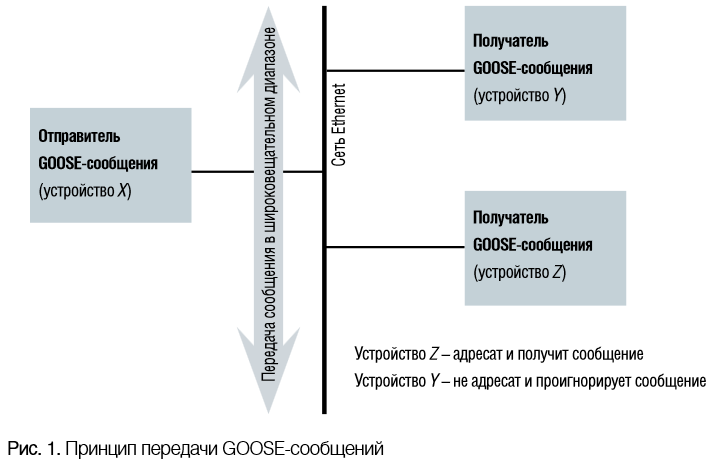
Устройство-отправитель передает по сети Ethernet информацию в широковещательном диапазоне.
В сообщении присутствует адрес отправителя и адреса, по которым осуществляется его передача, а также значение сигнала (например «0» или «1»).
Устройство-получатель получит сообщение, а все остальные устройства его проигнорируют.
Поскольку передача GOOSE-сообщений осуществляется в широковещательном диапазоне, т.е. нескольким адресатам, подтверждение факта получения адресатами сообщения отсутствует. По этой причине передача GOOSE-сообщений в установившемся режиме производится с определенной периодичностью.
При наступлении нового события в системе (например, КЗ и, как следствие, пуска измерительных органов защиты) начинается спонтанная передача сообщения через увеличивающиеся интервалы времени (например, 1 мс, 2 мс, 4 мс и т.д.). Интервалы времени между передаваемыми сообщениями увеличиваются, пока не будет достигнуто предельное значение, определяемое пользователем (например, 50 мс). Далее, до момента наступления нового события в системе, передача будет осуществляется именно с таким периодом. Указанное проиллюстрировано на рис. 2.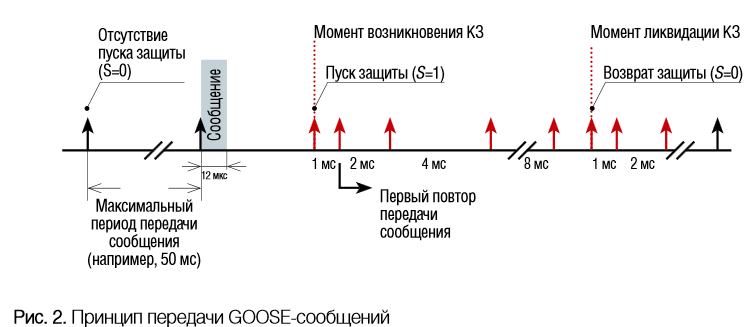
Технология повторной передачи не только гарантирует получение адресатом сообщения, но также обеспечивает контроль исправности линии связи и устройств – любые неисправности будут обнаружены по истечении максимального периода передачи GOOSE-сообщений (с точки зрения эксплуатации практически мгновенно). В случае передачи сигналов традиционным образом неисправность выявляется либо в процессе плановой проверки устройств, либо в случае неправильной работы системы РЗА.
Еще одной особенностью передачи GOOSE-сообщений является использование функций установки приоритетности передачи телеграмм (priority tagging) стандарта Ethernet IEEE 802.3u, которые не используются в других протоколах, в том числе уровня TCP/IP. То есть GOOSE-сообщения идут в обход «нормальных» телеграмм с более высоким приоритетом (см. рис. 3).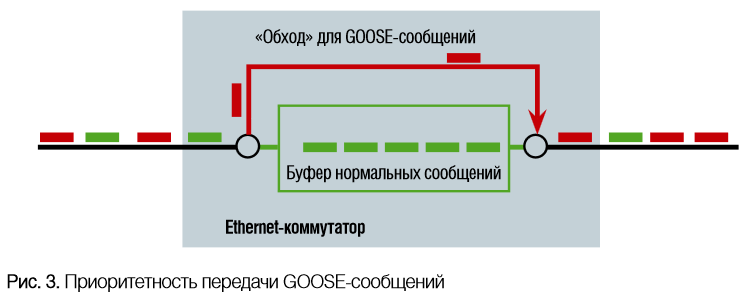
Однако стандарт МЭК 61850 декларирует передачу не только дискретной информации между терминалами РЗА, но и аналоговой. Это означает, что в будущем будет иметься возможность передачи аналоговой информации от ТТ и ТН по цифровым каналам связи. На данный момент готовых решений по передаче аналоговой информации для целей РЗА (в рамках стандарта МЭК 61850) ни один из производителей не предоставляет.
Для того чтобы использовать GOOSE-сообщения для передачи дискретных сигналов между терминалами РЗА необходима достаточная надежность и быстродействие передачи GOOSE-сообщений. Надежность передачи GOOSE-сообщений обеспечивается следующим:- Протокол МЭК 61850 использует Ethernet-сеть, за счет этого выход из строя верхнего уровня АСУ ТП и любого из устройств РЗА не отражается на передаче GOOSE-сообщений оставшихся в работе устройств,
- Терминалы РЗА имеют два независимых Ethernet-порта, при выходе одного из них из строя второй его полностью заменяет,
- Сетевые коммутаторы, к которым подключаются устройства РЗА, соединяются в два независимых «кольца»,
- Разные порты одного терминала РЗА подключаются к разным сетевым коммутаторам, подключенным к разным «кольцам»,
- Каждый сетевой коммутатор имеет дублированное питание от разных источников,
- Во всех устройствах РЗА осуществляется постоянный контроль возможности прохождения каждого сигнала. Это позволяет автоматически определить не только отказы цифровой связи, но и ошибки параметрирования терминалов.
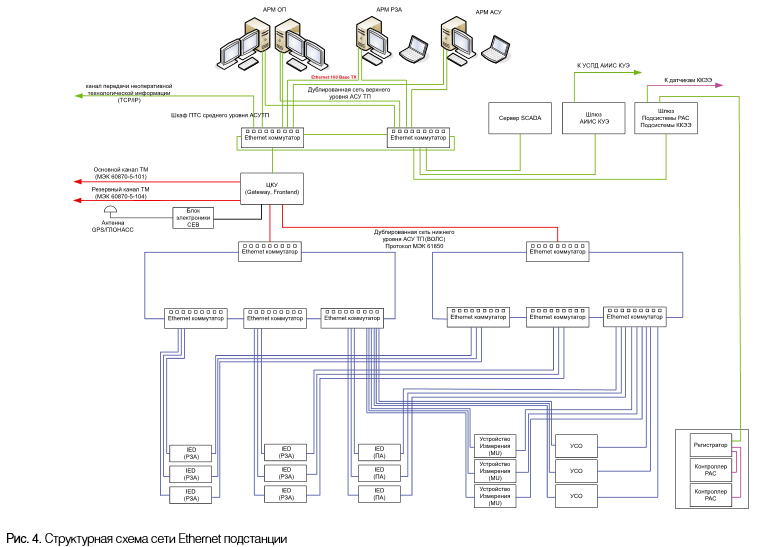
На рис. 4 изображен пример структурной схемы сети Ethernet (100 Мбит/c) подстанции. Отказ в передаче GOOSE-сообщения от одного устройства защиты другому возможен в результате совпадения как минимум двух событий. Например, одновременный отказ двух коммутаторов, к которым подключено одно устройство или одновременный отказ обоих портов одного устройства. Могут быть и более сложные отказы, связанные с одновременным наложением большего количества событий. Таким образом, единичные отказы оборудования не могут привести к отказу передачи GOOSEсообщений. Дополнительно увеличивает надежность то обстоятельство, что даже в случае отказа в передаче GOOSE-сообщения, устройство, принимающее сигнал, выдаст сигнал неисправности, и персонал примет необходимые меры для ее устранения.
Быстродействие.
В соответствии с требованиями стандарта МЭК 61850 передача GOOSE-сообщений должна осуществляться со временем не более 4 мс (для сообщений, требующих быстрой передачи, например, для передачи сигналов срабатывания защит, пусков АПВ и УРОВ и т.п.). Вообще говоря, время передачи зависит от топологии сети, количества устройств в ней, загрузки сети и загрузки вычислительных ресурсов терминалов РЗА, версии операционной системы терминала, коммуникационного модуля, типа центрального процессора терминала, количества коммутаторов и некоторых других аспектов. Поэтому время передачи GOOSE-сообщений должно быть подтверждено опытом эксплуатации.
Используя для передачи дискретных сигналов GOOSE-сообщения необходимо обращать внимание на то обстоятельство, что при использовании аппаратуры некоторых производителей, в случае отказа линии связи, значение передаваемого сигнала может оставаться таким, каким оно было получено в момент приема последнего сообщения.
Однако при отказе связи бывают случаи, когда сигнал должен принимать определенное значение. Например, значение сигнала блокировки МТЗ ввода 6–10 кВ в логике ЛЗШ при отказе связи целесообразно установить в значение «1», чтобы при КЗ на отходящем присоединении не произошло ложного отключения ввода. Так, к примеру, при проектировании терминалов фирмы Siemens изменить значение сигнала при отказе связи возможно с помощью свободно-программируемой CFCлогики (см. рис. 5).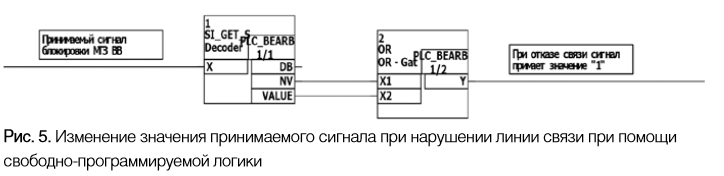
К CFC-блоку SI_GET_STATUS подводится принимаемый сигнал, на выходе блока мы можем получить значение сигнала «Value» и его статус «NV». Если в течение определенного времени не поступит сообщение со значением сигнала, статус сигнала «NV» примет значение «1». Далее статус сигнала и значение сигнала подводятся к элементу «ИЛИ», на выходе которого будет получено значение сигнала при исправности линии связи или «1» при нарушении исправности линии связи. Изменив логику, можно установить значение сигнала равным «0» при обрыве связи.
Использование GOOSE-сообщений предъявляет специальные требования к наладке и эксплуатации устройств РЗА. Во многом процесс наладки становится проще, однако при выводе устройства из работы необходимо следить не только за выводом традиционных цепей, но и не забывать отключать передачу GOOSE-сообщений.
При изменении параметрирования одного устройства РЗА необходимо производить загрузку файла параметров во все устройства, с которыми оно было связано.
В нашей стране имеется опыт внедрения и эксплуатации систем РЗА с передачей дискретных сигналов с использованием GOOSE-сообщений. На первых объектах GOOSE-сообщения использовались ограниченно (ПС 500 кВ «Алюминиевая»).
На ПС 500 кВ «Воронежская» GOOSEсообщения использовались для передачи сигналов пуска УРОВ, пуска АПВ, запрета АПВ, действия УРОВ на отключение смежного элемента, положения коммутационных аппаратов, наличия/отсутствия напряжения, сигналы ЛЗШ, АВР и т.п. Кроме того, на ОРУ 500 кВ и 110 кВ ПС «Воронежская» были установлены полевые терминалы, в которые собиралась информация с коммутационного оборудования и другая дискретная информация с ОРУ (рис. 6). Далее информация с помощью GOOSE-сообщений передавалась в терминалы РЗА, установленные в ОПУ подстанции (рис. 7, 8).
GOOSE-сообщения также были использованы при проектировании уже введенных в эксплуатацию ПС 500 кВ «Бескудниково», ПС 750 кВ «Белый Раст», ПС 330кВ «Княжегубская», ПС 220 кВ «Образцово», ПС 330 кВ «Ржевская». Эта технология применяется и при проектировании строящихся и модернизируемых подстанций ПС 500 кВ «Чагино», ПС 330кВ «Восточная», ПС 330 кВ «Южная», ПС 330 кВ «Центральная», ПС
330 кВ «Завод Ильич» и многих других.
Основные преимущества использования GOOSE-сообщений:- позволяет снизить количество кабелей вторичной коммутации на ПС;
- обеспечивает лучшую помехозащищенность канала связи;
- позволяет снизить время монтажных и пусконаладочных работ;
- исключает проблему излишнего срабатывания дискретных входов терминалов из-за замыканий на землю в цепях оперативного постоянного тока;
- убирает зависимость количества передаваемых сигналов от количества дискретных входов и выходных реле терминалов;
- обеспечивает возможность реконструкции и изменения связей между устройствами РЗА без прокладки дополнительных кабельных связей и повторного монтажа в шкафах;
- позволяет использовать МП терминалы РЗА с меньшим количеством входов и выходов (уменьшение габаритов и стоимости устройства);
- позволяет контролировать возможность прохождения сигнала (увеличивается надежность).
Безусловно, для окончательных выводов должен появиться достаточный опыт эксплуатации. В настоящее время большинство производителей устройств РЗА заявили о возможности использования GOOSEсообщений. Стандарт МЭК 61850 определяет передачу GOOSE-сообщений между терминалами разных производителей. Использование GOOSE-сообщений для передачи дискретных сигналов – это качественный скачок в развитии систем РЗА. С развитием стандарта МЭК 61850, переходом на Ethernet 1 Гбит/сек, с появлением новых цифровых ТТ и ТН, новых выключателей с возможностью подключения их блока управления к шине процесса МЭК 61850, эффективность использования GOOSE-сообщений намного увеличится. Облик будущих подстанций представляется с минимальным количеством контрольных кабелей, с передачей всех сообщений между устройствами РЗА, ТТ, ТН, коммутационными аппаратами через цифровую сеть. Устройства РЗА будут иметь минимальное количество выходных реле и дискретных входов
[ http://romvchvlcomm.pbworks.com/f/goosepaper1.pdf]
В стандарте определены два способа передачи данных напрямую между устройствами: GOOSE и GSSE. Это тоже пример наличия двух способов для реализации одной функции. GOOSE - более новый способ передачи сообщений, разработан специально для МЭК 61850. Способ передачи сообщений GSSE ранее присутствовал в стандарте UCA 2.0, являющимся одним из предшественников МЭК 61850. По сравнению с GSSE, GOOSE имеет более простой формат (Ethernet против стека OSI протоколов) и возможность передачи различных типов данных. Вероятно, способ GSSE включили в МЭК 61850 для того, чтобы производители, имеющие в своих устройствах протокол UCA 2.0, могли сразу декларировать соответствие МЭК 61850. В настоящее время все производители используют только GOOSE для передачи сообщений между устройствами.
Для выбора списка передаваемых данных в GOOSE, как и в отчѐтах, используются наборы данных. Однако тут требования уже другие. Время обработки GOOSE-сообщений должно быть минимальным, поэтому логично передавать наиболее простые типы данных. Обычно передаѐтся само значение сигнала и в некоторых случаях добавляется поле качества. Метка времени обычно включается в набор данных.
...
В устройствах серии БЭ2704 в передаваемых GOOSE-сообщениях содержатся данные типа boolean. Приниматься могут данные типа boolean, dbpos, integer.
Устоявшаяся тенденция существует только для передачи дискретной информации. Аналоговые данные пока передают немногие производители, и поэтому устоявшаяся тенденция в передаче аналоговой информации в данный момент отсутствует.
[ Источник]
Тематики
Синонимы
EN
Англо-русский словарь нормативно-технической терминологии > generic object oriented substation event
-
16 GOOSE
- широковещательное объектно-ориентированное сообщение о событии на подстанции
GOOSE-сообщение
-
[Интент]
широковещательное объектно-ориентированное сообщение о событии на подстанции
Широковещательный высокоскоростной внеочередной отчет, содержащий статус каждого из входов, устройств пуска, элементов выхода и реле, реальных и виртуальных.
Примечание. Этот отчет выдается многократно последовательно, как правило, сразу после первого отчета с интервалами 2, 4, 8,…, 60000 мс. Значение задержки первого повторения является конфигурируемым. Такой отчет обеспечивает выдачу высокоскоростных сигналов отключения с высокой вероятностью доставки.
[ ГОСТ Р 54325-2011 (IEC/TS 61850-2:2003)]
общие объектно-ориентированные события на подстанции
-
[ ГОСТ Р МЭК 61850-7-2-2009]
GOOSE
Generic Object Oriented Substation Event (стандарт МЭК 61850-8-1)
Протокол передачи данных о событиях на подстанции.
Один из трех протоколов передачи данных, предлагаемых к использованию в МЭК 61850.
Фактически данный протокол служит для замены медных кабельных связей, предназначенных для передачи дискретных сигналов между устройствами.
[ Цифровые подстанции. Проблемы внедрения устройств РЗА]EN
generic object oriented substation event
on the occurrence of any change of state, an IED will multicast a high speed, binary object, Generic Object Oriented Substation Event (GOOSE) report by exception, typically containing the double command state of each of its status inputs, starters, output elements and relays, actual and virtual.
This report is re-issued sequentially, typically after the first report, again at intervals of 2, 4, 8…60000 ms. (The first repetition delay value is an open value it may be either shorter or longer).
A GOOSE report enables high speed trip signals to be issued with a high probability of delivery
[IEC 61850-2, ed. 1.0 (2003-08)]До недавнего времени для передачи дискретных сигналов между терминалами релейной защиты и автоматики (РЗА) использовались дискретные входы и выходные реле. Передача сигнала при этом осуществляется подачей оперативного напряжения посредством замыкания выходного реле одного терминала на дискретный вход другого терминала (далее такой способ передачи будем называть традиционным).
Такой способ передачи информации имеет следующие недостатки:- необходимо большое количество контрольных кабелей, проложенных между шкафами РЗА,
- терминалы РЗА должны иметь большое количество дискретных входов и выходных реле,
- количество передаваемых сигналов ограничивается определенным количеством дискретных входов и выходных реле,
- отсутствие контроля связи между терминалами РЗА,
- возможность ложного срабатывания дискретного входа при замыкании на землю в цепи передачи сигнала.
Информационные технологии уже давно предоставляли возможность для передачи информации между микропроцессорными терминалами по цифровой сети. Разработанный недавно стандарт МЭК 61850 предоставил такую возможность для передачи сигналов между терминалами РЗА.
Стандарт МЭК 61850 использует для передачи данных сеть Ethernet. Внутри стандарта МЭК 61850 предусмотрен такой механизм, как GOOSE-сообщения, которые и используются для передачи сообщений между терминалами РЗА.
Принцип передачи GOOSE-сообщений показан на рис. 1.Устройство-отправитель передает по сети Ethernet информацию в широковещательном диапазоне.
В сообщении присутствует адрес отправителя и адреса, по которым осуществляется его передача, а также значение сигнала (например «0» или «1»).
Устройство-получатель получит сообщение, а все остальные устройства его проигнорируют.
Поскольку передача GOOSE-сообщений осуществляется в широковещательном диапазоне, т.е. нескольким адресатам, подтверждение факта получения адресатами сообщения отсутствует. По этой причине передача GOOSE-сообщений в установившемся режиме производится с определенной периодичностью.
При наступлении нового события в системе (например, КЗ и, как следствие, пуска измерительных органов защиты) начинается спонтанная передача сообщения через увеличивающиеся интервалы времени (например, 1 мс, 2 мс, 4 мс и т.д.). Интервалы времени между передаваемыми сообщениями увеличиваются, пока не будет достигнуто предельное значение, определяемое пользователем (например, 50 мс). Далее, до момента наступления нового события в системе, передача будет осуществляется именно с таким периодом. Указанное проиллюстрировано на рис. 2.Технология повторной передачи не только гарантирует получение адресатом сообщения, но также обеспечивает контроль исправности линии связи и устройств – любые неисправности будут обнаружены по истечении максимального периода передачи GOOSE-сообщений (с точки зрения эксплуатации практически мгновенно). В случае передачи сигналов традиционным образом неисправность выявляется либо в процессе плановой проверки устройств, либо в случае неправильной работы системы РЗА.
Еще одной особенностью передачи GOOSE-сообщений является использование функций установки приоритетности передачи телеграмм (priority tagging) стандарта Ethernet IEEE 802.3u, которые не используются в других протоколах, в том числе уровня TCP/IP. То есть GOOSE-сообщения идут в обход «нормальных» телеграмм с более высоким приоритетом (см. рис. 3).
Однако стандарт МЭК 61850 декларирует передачу не только дискретной информации между терминалами РЗА, но и аналоговой. Это означает, что в будущем будет иметься возможность передачи аналоговой информации от ТТ и ТН по цифровым каналам связи. На данный момент готовых решений по передаче аналоговой информации для целей РЗА (в рамках стандарта МЭК 61850) ни один из производителей не предоставляет.
Для того чтобы использовать GOOSE-сообщения для передачи дискретных сигналов между терминалами РЗА необходима достаточная надежность и быстродействие передачи GOOSE-сообщений. Надежность передачи GOOSE-сообщений обеспечивается следующим:- Протокол МЭК 61850 использует Ethernet-сеть, за счет этого выход из строя верхнего уровня АСУ ТП и любого из устройств РЗА не отражается на передаче GOOSE-сообщений оставшихся в работе устройств,
- Терминалы РЗА имеют два независимых Ethernet-порта, при выходе одного из них из строя второй его полностью заменяет,
- Сетевые коммутаторы, к которым подключаются устройства РЗА, соединяются в два независимых «кольца»,
- Разные порты одного терминала РЗА подключаются к разным сетевым коммутаторам, подключенным к разным «кольцам»,
- Каждый сетевой коммутатор имеет дублированное питание от разных источников,
- Во всех устройствах РЗА осуществляется постоянный контроль возможности прохождения каждого сигнала. Это позволяет автоматически определить не только отказы цифровой связи, но и ошибки параметрирования терминалов.
На рис. 4 изображен пример структурной схемы сети Ethernet (100 Мбит/c) подстанции. Отказ в передаче GOOSE-сообщения от одного устройства защиты другому возможен в результате совпадения как минимум двух событий. Например, одновременный отказ двух коммутаторов, к которым подключено одно устройство или одновременный отказ обоих портов одного устройства. Могут быть и более сложные отказы, связанные с одновременным наложением большего количества событий. Таким образом, единичные отказы оборудования не могут привести к отказу передачи GOOSEсообщений. Дополнительно увеличивает надежность то обстоятельство, что даже в случае отказа в передаче GOOSE-сообщения, устройство, принимающее сигнал, выдаст сигнал неисправности, и персонал примет необходимые меры для ее устранения.
Быстродействие.
В соответствии с требованиями стандарта МЭК 61850 передача GOOSE-сообщений должна осуществляться со временем не более 4 мс (для сообщений, требующих быстрой передачи, например, для передачи сигналов срабатывания защит, пусков АПВ и УРОВ и т.п.). Вообще говоря, время передачи зависит от топологии сети, количества устройств в ней, загрузки сети и загрузки вычислительных ресурсов терминалов РЗА, версии операционной системы терминала, коммуникационного модуля, типа центрального процессора терминала, количества коммутаторов и некоторых других аспектов. Поэтому время передачи GOOSE-сообщений должно быть подтверждено опытом эксплуатации.
Используя для передачи дискретных сигналов GOOSE-сообщения необходимо обращать внимание на то обстоятельство, что при использовании аппаратуры некоторых производителей, в случае отказа линии связи, значение передаваемого сигнала может оставаться таким, каким оно было получено в момент приема последнего сообщения.
Однако при отказе связи бывают случаи, когда сигнал должен принимать определенное значение. Например, значение сигнала блокировки МТЗ ввода 6–10 кВ в логике ЛЗШ при отказе связи целесообразно установить в значение «1», чтобы при КЗ на отходящем присоединении не произошло ложного отключения ввода. Так, к примеру, при проектировании терминалов фирмы Siemens изменить значение сигнала при отказе связи возможно с помощью свободно-программируемой CFCлогики (см. рис. 5).К CFC-блоку SI_GET_STATUS подводится принимаемый сигнал, на выходе блока мы можем получить значение сигнала «Value» и его статус «NV». Если в течение определенного времени не поступит сообщение со значением сигнала, статус сигнала «NV» примет значение «1». Далее статус сигнала и значение сигнала подводятся к элементу «ИЛИ», на выходе которого будет получено значение сигнала при исправности линии связи или «1» при нарушении исправности линии связи. Изменив логику, можно установить значение сигнала равным «0» при обрыве связи.
Использование GOOSE-сообщений предъявляет специальные требования к наладке и эксплуатации устройств РЗА. Во многом процесс наладки становится проще, однако при выводе устройства из работы необходимо следить не только за выводом традиционных цепей, но и не забывать отключать передачу GOOSE-сообщений.
При изменении параметрирования одного устройства РЗА необходимо производить загрузку файла параметров во все устройства, с которыми оно было связано.
В нашей стране имеется опыт внедрения и эксплуатации систем РЗА с передачей дискретных сигналов с использованием GOOSE-сообщений. На первых объектах GOOSE-сообщения использовались ограниченно (ПС 500 кВ «Алюминиевая»).
На ПС 500 кВ «Воронежская» GOOSEсообщения использовались для передачи сигналов пуска УРОВ, пуска АПВ, запрета АПВ, действия УРОВ на отключение смежного элемента, положения коммутационных аппаратов, наличия/отсутствия напряжения, сигналы ЛЗШ, АВР и т.п. Кроме того, на ОРУ 500 кВ и 110 кВ ПС «Воронежская» были установлены полевые терминалы, в которые собиралась информация с коммутационного оборудования и другая дискретная информация с ОРУ (рис. 6). Далее информация с помощью GOOSE-сообщений передавалась в терминалы РЗА, установленные в ОПУ подстанции (рис. 7, 8).
GOOSE-сообщения также были использованы при проектировании уже введенных в эксплуатацию ПС 500 кВ «Бескудниково», ПС 750 кВ «Белый Раст», ПС 330кВ «Княжегубская», ПС 220 кВ «Образцово», ПС 330 кВ «Ржевская». Эта технология применяется и при проектировании строящихся и модернизируемых подстанций ПС 500 кВ «Чагино», ПС 330кВ «Восточная», ПС 330 кВ «Южная», ПС 330 кВ «Центральная», ПС
330 кВ «Завод Ильич» и многих других.
Основные преимущества использования GOOSE-сообщений:- позволяет снизить количество кабелей вторичной коммутации на ПС;
- обеспечивает лучшую помехозащищенность канала связи;
- позволяет снизить время монтажных и пусконаладочных работ;
- исключает проблему излишнего срабатывания дискретных входов терминалов из-за замыканий на землю в цепях оперативного постоянного тока;
- убирает зависимость количества передаваемых сигналов от количества дискретных входов и выходных реле терминалов;
- обеспечивает возможность реконструкции и изменения связей между устройствами РЗА без прокладки дополнительных кабельных связей и повторного монтажа в шкафах;
- позволяет использовать МП терминалы РЗА с меньшим количеством входов и выходов (уменьшение габаритов и стоимости устройства);
- позволяет контролировать возможность прохождения сигнала (увеличивается надежность).
Безусловно, для окончательных выводов должен появиться достаточный опыт эксплуатации. В настоящее время большинство производителей устройств РЗА заявили о возможности использования GOOSEсообщений. Стандарт МЭК 61850 определяет передачу GOOSE-сообщений между терминалами разных производителей. Использование GOOSE-сообщений для передачи дискретных сигналов – это качественный скачок в развитии систем РЗА. С развитием стандарта МЭК 61850, переходом на Ethernet 1 Гбит/сек, с появлением новых цифровых ТТ и ТН, новых выключателей с возможностью подключения их блока управления к шине процесса МЭК 61850, эффективность использования GOOSE-сообщений намного увеличится. Облик будущих подстанций представляется с минимальным количеством контрольных кабелей, с передачей всех сообщений между устройствами РЗА, ТТ, ТН, коммутационными аппаратами через цифровую сеть. Устройства РЗА будут иметь минимальное количество выходных реле и дискретных входов
[ http://romvchvlcomm.pbworks.com/f/goosepaper1.pdf]
В стандарте определены два способа передачи данных напрямую между устройствами: GOOSE и GSSE. Это тоже пример наличия двух способов для реализации одной функции. GOOSE - более новый способ передачи сообщений, разработан специально для МЭК 61850. Способ передачи сообщений GSSE ранее присутствовал в стандарте UCA 2.0, являющимся одним из предшественников МЭК 61850. По сравнению с GSSE, GOOSE имеет более простой формат (Ethernet против стека OSI протоколов) и возможность передачи различных типов данных. Вероятно, способ GSSE включили в МЭК 61850 для того, чтобы производители, имеющие в своих устройствах протокол UCA 2.0, могли сразу декларировать соответствие МЭК 61850. В настоящее время все производители используют только GOOSE для передачи сообщений между устройствами.
Для выбора списка передаваемых данных в GOOSE, как и в отчѐтах, используются наборы данных. Однако тут требования уже другие. Время обработки GOOSE-сообщений должно быть минимальным, поэтому логично передавать наиболее простые типы данных. Обычно передаѐтся само значение сигнала и в некоторых случаях добавляется поле качества. Метка времени обычно включается в набор данных.
...
В устройствах серии БЭ2704 в передаваемых GOOSE-сообщениях содержатся данные типа boolean. Приниматься могут данные типа boolean, dbpos, integer.
Устоявшаяся тенденция существует только для передачи дискретной информации. Аналоговые данные пока передают немногие производители, и поэтому устоявшаяся тенденция в передаче аналоговой информации в данный момент отсутствует.
[ Источник]
Тематики
Синонимы
EN
Англо-русский словарь нормативно-технической терминологии > GOOSE
См. также в других словарях:
Command.com — Le programme COMMAND.COM est l interpréteur de commandes du système MS DOS. On ne le confondra pas avec cmd.exe, qui est l interpréteur de commande de Windows NT (Windows 2000, Windows XP...) et d OS/2. Les commandes de cmd.exe sont inspirées,… … Wikipédia en Français
Command and obedience in the Bundeswehr — The principle of command and obedience in the Bundeswehr (German: Befehl und Gehorsam), along with the concept of citizens in uniform (German: Staatsbürger in Uniform), was central to the 1953 idea of leadership development and civic education… … Wikipedia
Guarded Command Language — The Guarded Command Language (GCL) is a language defined by Edsger Dijkstra for predicate transformer semantics cite web | last=Dijkstra | first=Edsger W | authorlink=E. W. Dijkstra | url=http://www.cs.utexas.edu/users/EWD/ewd04xx/EWD472.PDF |… … Wikipedia
Kane (Command & Conquer) — Within the fictional alternate history universe of Westwood Studios and Electronic Arts Command Conquer real time strategy video games, Kane is the seemingly immortal mastermind behind the ancient and secretive Brotherhood of Nod society. Little… … Wikipedia
Air Command for Military Transportation — CATAM redirects here. For Computer Aided Teaching of All Mathematics, an optional component of the Mathematics course at Cambridge University, see Cambridge Mathematical Tripos. Air Command for Military Transportation, (English for Commando Aéreo … Wikipedia
Army Physical Fitness Test — The Army Physical Fitness Test (APFT) is designed to test the muscular strength/endurance and cardiovascular respiratory fitness of soldiers in the United States Army. Soldiers are given a score based on their performance in three events… … Wikipedia
MUSIC — This article is arranged according to the following outline: introduction written sources of direct and circumstantial evidence the material relics and iconography notated sources oral tradition archives and important collections of jewish music… … Encyclopedia of Judaism
biblical literature — Introduction four bodies of written works: the Old Testament writings according to the Hebrew canon; intertestamental works, including the Old Testament Apocrypha; the New Testament writings; and the New Testament Apocrypha. The Old… … Universalium
Military parade — The Grenadier Guards on parade outside Buckingham Palace, London … Wikipedia
international relations — a branch of political science dealing with the relations between nations. [1970 75] * * * Study of the relations of states with each other and with international organizations and certain subnational entities (e.g., bureaucracies and political… … Universalium
Extreme Unction — • A sacrament to give spiritual aid and comfort and perfect spiritual health, including, if need be, the remission of sins, and also, conditionally, to restore bodily health, to Christians who are seriously ill Catholic Encyclopedia. Kevin Knight … Catholic encyclopedia
